

Best Foam Rollers: What the Research Actually Supports (and What It Doesn’t)

Table of Contents
Introduction: Best Foam Rollers
Foam rollers have become a staple in the training routines of many athletes, and I’m no exception—I own several myself. One reason I keep using them is that they make it much easier to apply sustained pressure to areas that are otherwise difficult to reach effectively on your own, particularly the muscles around the upper back and the gluteal region. From a practical standpoint, that’s a genuinely useful feature regardless of what the research ultimately says about their broader physiological effects.
At the same time, foam rollers have accumulated an almost endless list of claims. They’re marketed as a solution for delayed-onset muscle soreness, faster recovery, muscle pain, “tight fascia,” “locked” IT bands, trigger points, mobility restrictions, and just about every other soft-tissue problem an athlete might encounter. The scientific evidence doesn’t support all of these claims equally. Some applications are backed by reasonably consistent research, others have only limited evidence, and at least one commonly promoted acute mechanical mechanism has not been supported in a controlled trial.
From a clinical perspective, I also find that many athletes are unsure which of these claims are genuinely evidence-based and which are largely driven by marketing. That’s the reason I wrote this guide. Rather than trying to identify a single “best” foam roller, we’ll look at what the research actually supports for each specific use case, where the evidence remains uncertain, and which types of foam rollers are most appropriate for different purposes. In other words, there isn’t one best foam roller for everything—the best choice depends on what you’re actually trying to achieve.
Some of the links on this site are affiliate links. If you purchase a product through these links, I may earn a commission. This doesn’t cost you anything, but it helps me maintain this page so I can continue to share free information with the world. As an Amazon Associate, I earn from qualifying purchases. Product links are provided for informational and convenience purposes only. Their inclusion does not constitute medical or nutritional advice or a personalized recommendation.
The Best Foam Roller for Post-Workout Recovery and Muscle Soreness
If you’re trying to identify the best foam roller for cutting post-workout soreness, this is the best-supported category to start with. Foam rolling after exercise has the most direct support of any use case here. A 2026 systematic review of five controlled studies reported a significant reduction in delayed-onset muscle soreness (DOMS) in the 48–72 hour window after exercise, with improvements showing up in pain ratings, biochemical markers, and physical-performance measures, and characterized both the methodological quality and the overall evidence as moderate [1]. A separate meta-analysis of randomized controlled trials specifically on foam rolling for exercise-induced muscle soreness reached broadly the same conclusion [2].
A separate meta-analysis of randomized controlled trials focusing specifically on foam rolling for exercise-induced muscle soreness reached similar conclusions, reporting small to moderate reductions in perceived muscle soreness following exercise [2].
A large meta-analysis comparing foam rolling applied before versus after exercise found that post-exercise rolling produced a moderate reduction in perceived muscle pain (+6.0% relative improvement, effect size g = 0.47) and a small-to-moderate attenuation of exercise-induced drops in sprint and strength performance (g = 0.34 and g = 0.21 respectively), with foam rollers tending to outperform roller-massage sticks specifically on strength-performance recovery [3].
The important caveat: this is a subjective-pain and short-term-performance effect, not evidence that foam rolling accelerates the underlying biological repair process. One controlled study measuring gastrocnemius muscle circumference and ROM alongside pain ratings found a significant improvement in perceived soreness 24 hours after foam rolling, but no significant change in muscle circumference or ROM [10] — worth noting as a caveat rather than proof either way, since circumference and ROM are only two specific, indirect measures in one small study (n=20), not a comprehensive read on tissue damage. So the honest claim is “feels less sore, and may modestly reduce short-term drops in sprint and strength performance,” not “heals the muscle faster.”
The important caveat is that these findings support an effect on perceived soreness and, based on separate performance research, modest attenuation of short-term declines in sprint and strength—not evidence that foam rolling accelerates biological tissue repair [3][10]. In one small controlled study involving 20 participants, perceived soreness improved 24 hours after foam rolling, while no significant differences were detected in gastrocnemius circumference or ROM [10]. These were only two indirect recovery measures, so the study neither proves nor rules out an effect on the underlying repair process.

TriggerPoint GRID 1.0 Foam Roller
| Pros | Cons |
|---|---|
| (Users) Firm, targeted pressure frequently described as effective on knots without being painful | (Users) Priced noticeably higher than basic foam rollers, a recurring complaint |
| (Users) Holds its shape over years of regular use, even under body weights up to the rated capacity | (Users) 13″ length limits full-back coverage for larger or taller users; firmness described by a minority as more intense than expected |
| (Product feature) Textured, multi-density surface designed to vary the contact sensation across the roller | (Evidence) Evidence above is for foam rolling as a category (mostly generic/lab-grade rollers), not this specific branded product — no trial in this section tested the GRID by name |
| (Practical) Compact (13″) and easy to transport, which may make regular post-session use more convenient | (Evidence) No independent evidence that the textured “Distrodensity” pattern outperforms a plain foam cylinder for the soreness/pain outcomes above — that comparison hasn’t been isolated in the cited trials |
The reduction in subjective soreness described above shows up with foam rolling generally; study protocols varied substantially, but most used brief repeated rolling bouts directed at the exercised muscle groups. Current evidence supports foam rolling as a general intervention but doesn’t establish that a particular commercial surface texture produces greater soreness relief — so a basic roller of similar firmness may reasonably be expected to provide similar general benefits, though direct equivalence with the GRID hasn’t been demonstrated. What the GRID buys you over a plain cylinder is durability and a design built specifically around targeted post-workout use, not a documented larger soreness reduction.
What buyers say about the TriggerPoint GRID 1.0 Foam Roller: Across the reviews surfaced, the recurring theme is that the textured surface is firm without feeling punishing, and that it noticeably outperforms a plain roller at working into calves, backs, and other tight spots — several long-term owners specifically note the hollow core holds its shape rather than going soft after years of regular use. The most common friction points are price (buyers repeatedly compare it unfavorably on cost to basic rollers) and its 13-inch length, which some larger or taller users find limiting for full-back coverage. A smaller number of reviewers, especially first-time rollers, describe the firmness as more intense than expected.
I used to think of foam rolling—and even sports massage—primarily as ways to speed up recovery itself. Looking at the current evidence, my perspective has changed. From a clinical standpoint, the strongest indication for foam rolling is to reduce muscle soreness, particularly during the first few days after strenuous exercise. If feeling less sore helps you train, move, or simply function more comfortably, that’s a worthwhile benefit in its own right. But it’s different from claiming that the muscle has actually healed faster, and the current evidence doesn’t allow us to make that conclusion.
The Best Foam Roller for Flexibility and Range of Motion
For anyone chasing the best foam roller for long-term flexibility gains, this is one of the better-supported use cases for foam rolling. A meta-analysis of 11 controlled trials (290 participants, 46 effect sizes) found a moderate effect of foam-rolling training (repeated sessions over time, not a single bout) on joint range of motion (effect size = 0.823, 95% CI 0.325–1.322, p = 0.001) [4]. A separate meta-analysis of 13 ROM studies (18 datasets) found a large effect (d = 0.76, 95% CI 0.55–0.98), with range-of-motion gains appearing in every study included in that analysis — though this analysis didn’t break results out by intervention duration the way [4] and [6] below do, so it’s best read as general confirmation that foam rolling helps ROM rather than as separate evidence specifically about long-term training [5].
The evidence has real structure worth naming rather than smoothing over: the ROM benefit is muscle-specific (foam rolling improved ROM for hamstrings and quadriceps but not ankle dorsiflexion when applied to the calf/triceps surae in the same analysis) [4]. It’s also important to separate two different questions: a single foam-rolling session can produce a real, acute, short-lived increase in ROM (this is what [5] and most single-session studies measure) — but that’s different from whether repeated foam-rolling training over time produces additional benefit. On that second question, a direct comparison of foam-rolling training against static stretching found a significant ROM improvement from foam rolling over longer interventions, but not over training programs of 4 weeks or less (effect size −0.229, p = 0.248 at ≤ 4 weeks, versus a significant stretching-only effect at that same short duration) [6]. That comparison measured the effect present at the end of each intervention length, not how long any gain lasts after you stop — so in other words: a single rolling session can loosen things up temporarily, and repeated programs lasting more than about a month showed a significant training effect where programs of 4 weeks or less did not, roughly comparable in magnitude to static stretching over that longer timeframe.
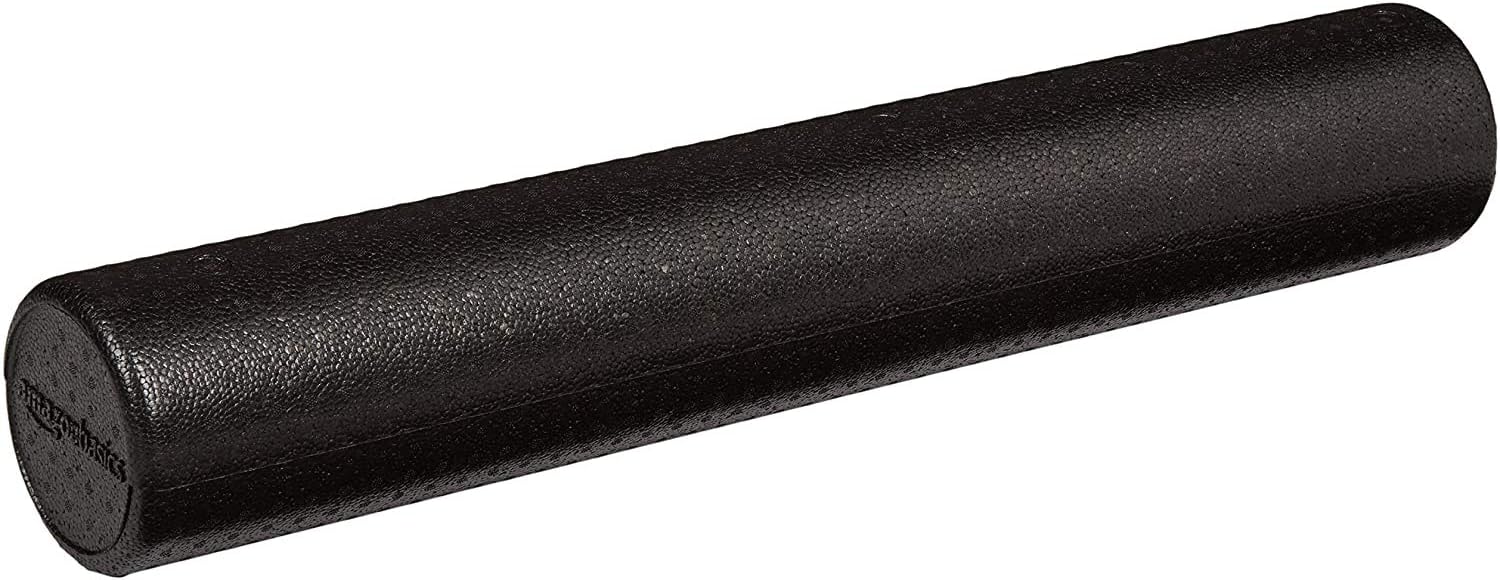
Amazon Basics High-Density Foam Roller, 36″
| Pros | Cons |
|---|---|
| (Users) Praised repeatedly for back pain relief, posture work, and full-body coverage at low cost | (Users) Firmness described as more intense than expected by multiple first-time users |
| (Users) Holds its shape and density over repeated use, according to longer-term owners | (Users) A minority describe the foam texture/quality as feeling basic for the price; no targeted texture, unlike some competitors |
| (Product feature) Plain, smooth, high-density (EPP) surface; the cited ROM literature does not establish that a textured or branded surface is required for benefit | (Evidence) No trial-level verification of this specific SKU’s density or durability against the exact rollers used in the cited studies |
| (Practical) Its length allows broad contact across larger muscle groups such as the hamstrings and quadriceps in a single pass | (Practical) The high-density EPP construction may feel relatively firm, particularly to beginners |
This is a case where a basic, inexpensive roller is a genuinely defensible pick rather than a compromise: the cited ROM literature doesn’t demonstrate superior ROM gains from textured, vibrating, or premium-branded rollers, so paying more for one isn’t clearly supported by this particular body of evidence. What matters more, per the duration finding above, is sticking with a training program past the 4-week mark.
What buyers say about the Amazon Basics High-Density Foam Roller, 36″: Reviewers consistently credit the length and value here — it’s repeatedly described as effective for back pain relief, posture work, and full-body use, and several long-term owners note it holds its density well rather than compressing over time. The most common complaint is firmness: more than one reviewer describes it as harder or more intense than expected out of the box, and a few describe the foam as feeling comparatively basic or “cheap” for what it is, though usually still rated as acceptable for the price. A handful of buyers say they’d have preferred a smaller diameter or a different length for their build.
Overall, foam rolling is a surprisingly versatile tool. Beyond its role in reducing post-exercise soreness, it can also contribute to improving range of motion when used consistently over time. From a practical perspective, one of its greatest advantages is that it allows you to apply sustained, targeted pressure to muscle groups that are otherwise difficult to treat on your own.
In my own experience, that’s one of the main reasons I continue to use foam rollers. Reaching areas such as the upper back or the gluteal muscles can be challenging without another person or a massage therapist. A foam roller provides a simple way to use your own body weight to apply controlled pressure to those regions, making self-treatment far more practical. Whether that pressure produces exactly the same effects as manual massage is a separate question, but the convenience and independence it offers are genuine advantages for many active people.
The Best Foam Roller for Pre-Workout Warm-Up
The best foam roller for warming up before training is a different question from the recovery question above — smaller effects, but real. Foam rolling before exercise (“pre-rolling”) has real but modest support, and it’s clearly weaker than the recovery and ROM cases above. The same large meta-analysis cited earlier found that pre-exercise foam rolling produced only a small improvement in sprint performance (+0.7%, g = 0.28) and flexibility (+4.0%, g = 0.34), while its effect on jump performance (−1.9%, g = 0.09) and strength (+1.8%, g = 0.12) was negligible [3]. The authors’ own conclusion was that the evidence justifies foam rolling as a warm-up activity more than as a recovery tool for performance specifically — worth noting since it cuts against the more common marketing framing of foam rolling as primarily a recovery product [3].
Vibration adds a genuinely separate research question here, and the evidence is still early. A systematic review of eight studies (2019–2024) on vibrating foam rollers found benefits for reducing DOMS, improving pressure-pain threshold, and lowering subjective fatigue, with some studies also showing increased ROM at the hip and knee — but findings were inconsistent across studies for physiological markers like muscle oxygen saturation and blood flow, and the review’s own conclusion was that vibration “may offer potential benefits,” not that it’s established to outperform standard rolling [7]. This is a Tier 2, early-but-promising category: real signal on subjective and some objective outcomes, but the physiological picture is inconsistent and the number of trials is still small (eight studies total), so treat any specific-percentage claim about vibration’s added benefit over plain rolling with caution — the review didn’t isolate one.
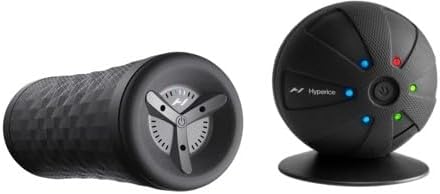
Hyperice Vyper 3 Vibrating Foam Roller
| Pros | Cons |
|---|---|
| (Users) Vibration strength and adjustability consistently praised, including by users managing chronic back tightness | (Users) Noticeably noisy at higher vibration settings, per multiple reviewers |
| (Users) Solid, premium-feeling build quality noted across reviews | (Users) A few reviewers found the power/setting mechanism fiddly or unintuitive; with vibration off, some rate the roller itself as unremarkable relative to its price |
| (Evidence) Vibration foam rolling has been studied as a distinct intervention (as opposed to plain rolling), so this is a case where the added feature has its own — if still limited — evidence base | (Evidence) The reviewed studies could not reliably isolate vibration’s independent contribution from the pressure and friction of standard rolling — this is a thinner, less isolated evidence base than the plain-roller categories above |
| Multiple speed settings allow matching intensity to a pre-workout vs. post-workout context (a product feature, not something the cited review specifically tested) | (Evidence) Vibrating rollers cost substantially more than standard foam rollers, and the meta-analytic pre-rolling effect sizes above are small even before accounting for the vibration add-on |
What buyers say about the Hyperice Vyper 3 Vibrating Foam Roller: User sentiment is strongly positive on the vibration itself — reviewers, including several managing chronic back pain, repeatedly describe it as a meaningful step up from a plain roller and credit it with faster perceived warm-up and looser muscles. Reported downsides cluster around three things: noise at higher vibration settings, a power/on-off mechanism a few reviewers found fiddly or unintuitive, and price relative to a non-vibrating roller — a small number of reviewers who directly compare the unit with vibration off to a plain roller describe that baseline experience as unremarkable, suggesting the premium is really paying for the motor rather than the foam itself.
The idea of combining vibration with soft-tissue treatment isn’t entirely new. Long before vibrating foam rollers became available, handheld vibrating massage devices were already on the market. From my perspective, what makes a vibrating foam roller different is the combination of vibration with sustained body-weight pressure rather than vibration alone.
In practice, that combination is appealing because you can apply substantially more pressure to larger muscle groups than is usually possible with a handheld device. Whether that translates into clinically meaningful advantages over a standard foam roller is still uncertain, and the current evidence remains limited. Even so, it’s a logical concept that deserves further study rather than being dismissed simply because the technology is relatively new.
The Best Foam Roller for Trigger Points and Muscle “Knots”
The best foam roller for tight spots and “knots” comes with a mechanism caveat worth reading before you buy. This category needs an upfront correction to the marketing language before any product recommendation makes sense. Foam rolling for “trigger points” is usually sold as “myofascial release” — the idea that rolling physically breaks up fascial adhesions or restrictions. A narrative review specifically examining this mechanism concluded there is insufficient evidence that the primary mechanism behind foam rolling is the release of myofascial restrictions at all, and stated plainly that the term “self-myofascial release” is misleading as a description of what’s actually happening [8]. The same review noted that identification of trigger points by touch is not itself highly reliable, and proposed several alternative mechanisms behind rolling’s effect on pain and tension — changes in tissue thixotropic (gel-like) properties, temporary shifts in blood flow, activation of skin and fascial mechanoreceptors, and a nervous-system shift toward a more relaxed (parasympathetic) state — without claiming any one of these is confirmed or that adhesion-breaking is ruled out entirely [8].
That doesn’t mean rolling a tight spot does nothing — the pain-threshold and DOMS effects documented in the recovery section above are real and measurable. It means the specific “breaking up knots” framing on most product packaging isn’t what the mechanism research actually supports. This is a case for including a product while explicitly correcting the claim under which it’s usually sold, rather than either recommending it uncritically or refusing to recommend anything.

321 STRONG Textured Foam Roller
| Pros | Cons |
|---|---|
| (Users) Dual-texture surface liked for varying pressure and reaching tight spots a plain roller doesn’t; praised by runners and physical-therapy patients for lower-back and leg tightness | (Users) Transition between textured and flat sections described as abrupt or distracting by multiple reviewers |
| (Users) Compact and durable enough for repeated travel use | (Users) Some first-time users report a short learning curve and extra soreness in the first few sessions; a few found it bulkier than expected for a “travel” product |
| (Product feature) Textured, multi-zone surface designed to concentrate pressure over smaller areas — the cited mechanism research does not show that this specific design improves pain or pressure-threshold outcomes compared with a smooth roller | (Evidence) Marketed explicitly as breaking up “adhesions” and releasing trigger points — language the cited mechanism review found is not well supported; buy it for the pressure/sensory effect, not the literal-release claim |
| (Practical) Medium density may feel more tolerable to some beginners than a very firm textured roller | (Evidence) No trial in the mechanism literature above tested this specific product; not shown to outperform a plain roller for pain relief specifically |
What buyers say: Reviewers generally like being able to shift between the roller’s two textures to vary pressure, and several — including runners and physical-therapy patients — describe it as reaching tight spots a plain roller doesn’t. It’s also repeatedly praised for being compact and durable enough for travel. The most consistent complaint is that the transition between the textured and flat sections feels abrupt mid-roll, which some reviewers find distracting rather than useful; a few first-time users also describe a short learning curve, with noticeable soreness after their first sessions before it eased off.
One of the most persistent myths surrounding foam rolling is the idea that tight muscles are physically “stuck” together by adhesions or scar tissue that simply need to be broken apart with enough pressure. In my clinical experience, many patients describe exactly this model—they feel a tight or tender area, assume that the tissue has become mechanically bound down, and believe it needs to be aggressively “worked loose” [8].
The current understanding of muscle physiology is more nuanced. Muscles are not passive structures waiting to be mechanically freed. Instead, muscle tone, pain, and the sensation of stiffness are influenced by a complex interaction between the muscles themselves, connective tissue, and the nervous system. This helps explain why the immediate effects of foam rolling are unlikely to come from physically breaking adhesions. Instead, current research suggests that changes in pain perception, mechanoreceptor input, local tissue mechanics, or other neurophysiological processes are more plausible explanations, although no single mechanism has been definitively established [8].
IT Band Syndrome: No Foam Roller Recommendation
If you were hoping the best foam roller could fix IT band pain outright, the direct trial evidence says otherwise. Foam rolling the IT band is one of the most commonly recommended self-treatments for lateral knee pain in runners, and it’s also the clearest example in this article of a specific, popular claim that a controlled trial directly tested and did not support. A randomized controlled trial measuring actual iliotibial band stiffness found that a single bout of foam rolling — and, in the same trial, a single bout of stretching — produced no measurable change in ITB stiffness in healthy subjects [9]. This matters because the ITB is a dense band of fibrous connective tissue, not a contractile muscle — the biomechanical premise behind “loosening” it with a roller the way you’d loosen a tight quad is weaker to begin with, and this trial is direct evidence against a single session measurably reducing ITB stiffness in healthy adults.
This doesn’t mean rolling near the IT band is pointless — the tissue that actually attaches to and tensions the band (glutes, tensor fasciae latae, and the vastus lateralis of the quad) is contractile muscle, and general muscle-directed rolling in that area may plausibly produce the same pain-threshold and comfort effects documented in the recovery section above. But that’s a different, adjacent claim from “foam rolling releases the IT band itself,” which is the claim most commonly made and the one this trial tested directly. Per Step 0 of the evidence framework this article follows: a controlled trial found no acute effect on the specific mechanical mechanism being sold, so no product is recommended for IT band syndrome as a standalone use case here. IT band syndrome itself is a clinical condition with a broader picture than the acute stiffness question this one trial addressed — see a physical therapist or sports medicine physician for proper assessment rather than treating foam rolling as a standalone mechanical fix.
From a clinical perspective, IT band syndrome can be a frustrating condition to manage. In my own practice, I often involve a physiotherapist early in the rehabilitation process because there is rarely a single intervention that resolves the problem on its own. Instead, treatment typically requires a broader approach that may include load modification, progressive exercise therapy, and addressing contributing factors identified during the assessment. In my experience, there is no single “magic fix”—either from foam rolling or from the medical side of care—and setting realistic expectations is often an important part of successful management.
Comparison Table
| Category | Evidence tier | Product | Best for |
|---|---|---|---|
| Post-workout recovery / soreness | Tier 1 (moderate) | TriggerPoint GRID 1.0 | Reducing perceived soreness and short-term performance drop-off after hard sessions |
| Flexibility / range of motion | Tier 1 (moderate) | Amazon Basics High-Density Roller, 36″ | Building ROM over weeks of consistent use; texture doesn’t add documented benefit here |
| Pre-workout warm-up | Tier 2 (small, promising) | Hyperice Vyper (vibrating) | Vibration-assisted rolling; possible pain, fatigue, and ROM benefits, but added value over standard rolling remains uncertain |
| Trigger points / “knots” | Tier 3 (symptomatic pressure effect plausible; trigger-point mechanism unconfirmed) | 321 STRONG Textured Roller | Localized pressure and comfort; not literal adhesion release |
| IT band syndrome | Tier 3/4 (no acute change in ITB stiffness in healthy adults) | No pick | — see a clinician for proper assessment instead |
FAQ
Does foam rolling actually break up scar tissue or adhesions? The best available mechanism review found insufficient evidence for this and called the “myofascial release” framing misleading; it proposed blood flow, tissue thixotropic changes, and nervous-system effects as alternative explanations, without confirming any single mechanism [8].
How long before I see a flexibility benefit? The strongest ROM evidence is for training over more than 4 weeks; a short-term intervention of 4 weeks or less did not show a significant foam-rolling-specific ROM effect in a head-to-head comparison with stretching [6].
Should I foam roll before or after a workout? Both have support, but for different things: pre-workout rolling shows small benefits for flexibility and sprint performance; post-workout rolling shows a larger effect on perceived soreness and short-term recovery of strength and sprint performance [3]. So the best foam roller routine for you depends on which of those two effects you’re actually after.
Is a vibrating roller worth the extra cost? Possibly, but the vibration-specific evidence base is still small (eight studies) and inconsistent on physiological markers, even though it’s promising on pain and subjective fatigue [7].
Will foam rolling fix my IT band syndrome? A controlled trial found no measurable change in IT band stiffness from a single bout of foam rolling, so it shouldn’t be relied on as a standalone fix for this specific mechanism [9].
What This Means for Buyers
There’s no single best foam roller here — the right pick depends entirely on which use case above matches your goal.
- Post-workout recovery: worth having — moderate evidence for reduced soreness and modestly better short-term performance retention, though the one study measuring circumference and ROM directly didn’t find a change in those two specific markers.
- Flexibility/ROM: one of the best-supported use cases here — a single session can loosen things up temporarily, and the training evidence is more favorable for programs lasting more than 4 weeks than for shorter interventions.
- Pre-workout warm-up: a reasonable habit with small measurable benefits; don’t expect it to move jump or strength performance.
- Trigger points/knots: likely to feel useful, but buy it for pressure and sensory effects, not the “releases adhesions” marketing claim.
- IT band syndrome: don’t rely on a roller to fix this — the direct trial evidence doesn’t support the specific “loosening the band” mechanism acutely; see a clinician for proper assessment rather than treating rolling as a standalone fix.
Compared with many of the other recovery products I have reviewed, foam rollers are a genuinely credible category. I use them myself because they offer a practical way to apply pressure to sore or tight areas without needing another person. What surprised me when reviewing the literature was that the evidence is actually more favorable than I expected. In many recovery-product categories, the research is either extremely limited or almost absent, whereas foam rolling has been studied across several distinct outcomes, including soreness, range of motion, and short-term performance.
That does not mean foam rollers are a solution to every recovery problem, and expectations should remain realistic. Their benefits appear to be narrower than much of the marketing suggests, particularly when it comes to claims about faster tissue repair or mechanically “releasing” fascia.
Even so, there are times when some form of self-massage simply feels useful, whether after training or when a particular area feels uncomfortable. In that setting, a foam roller can be a practical and relatively inexpensive tool. It is also generally a smaller financial commitment than arranging even a single professional massage session. In my view, that combination of accessibility, convenience, and modest evidence-based benefits makes foam rollers a reasonable purchase—as long as they are treated as an adjunct rather than a cure-all.
References
- https://revistamentor.ec/index.php/mentor/article/view/10758
- https://www.sciencedirect.com/science/article/abs/pii/S1360859224004339
- https://www.ncbi.nlm.nih.gov/pmc/articles/PMC6465761/
- https://www.ncbi.nlm.nih.gov/pmc/articles/PMC9474417/
- https://www.sciencedirect.com/science/article/abs/pii/S1360859220300218
- https://www.ncbi.nlm.nih.gov/pmc/articles/PMC11393112/
- https://www.ncbi.nlm.nih.gov/pmc/articles/PMC12193259/
- https://link.springer.com/article/10.1007/s40279-019-01149-y
- https://ijspt.scholasticahq.com/article/23606-the-immediate-effects-of-foam-rolling-and-stretching-on-iliotibial-band-stiffness-a-randomized-controlled-trial
- https://link.springer.com/chapter/10.1007/978-981-95-0804-4_22


