

Best Treadmill for Home: What the Research Actually Supports (and What It Doesn’t)

Table of Contents
The best treadmill for home use depends on what you actually want the machine to do. Losing weight, training for a race, sitting less during the workday, and walking uphill to change knee loading are different goals, and the evidence behind each is not equally strong.
I have owned several treadmills for home use over the years, ranging from running treadmills to compact walking pads. I am a big fan of indoor workouts, although my wife generally prefers exercising outside. In practice, each setup has its own advantages. For me, one of the biggest benefits of exercising at home is simply that it lowers the threshold to get started. There is no need to pack a gym bag, travel anywhere, or even dress for the weather. You can step onto the treadmill almost immediately, which can make consistency easier. I also like being able to run at room temperature, and there are days when watching television during an easy session makes the workout feel more convenient rather than like another task that needs planning.
Walking pads add another dimension because they can also be used during desk work. I do not see that as a substitute for all other exercise, but it changes how a treadmill can fit into daily life: the machine does not necessarily have to be reserved for a separate workout. I even have a stair machine at home, but that is probably a different article.
That practical experience is part of why I have organized this guide by use case rather than ranking treadmills from 1 to 10. Each section starts with what the research actually supports for that particular goal, divided into broad evidence tiers: stronger support, early or limited evidence, or no controlled outcome evidence. Where the evidence is reasonably solid, I name a treadmill whose specifications fit the type of exercise studied. Where it is not, there is no pick.Importantly, none of the specific products below was tested in the studies I cite. They were selected because their specifications allow the type of exercise used in the research and, secondarily, because of buyer feedback. Where I write “I did not identify,” I mean that my literature searches did not find such a study. That is not the same as proving that no such study exists.
Some of the links on this site are affiliate links. If you purchase a product through these links, I may earn a commission. This doesn’t cost you anything, but it helps me maintain this page so I can continue to share free information with the world. As an Amazon Associate, I earn from qualifying purchases. Product links are provided for informational and convenience purposes only. Their inclusion does not constitute medical or nutritional advice or a personalized recommendation.
Best Treadmill for Home at a Glance
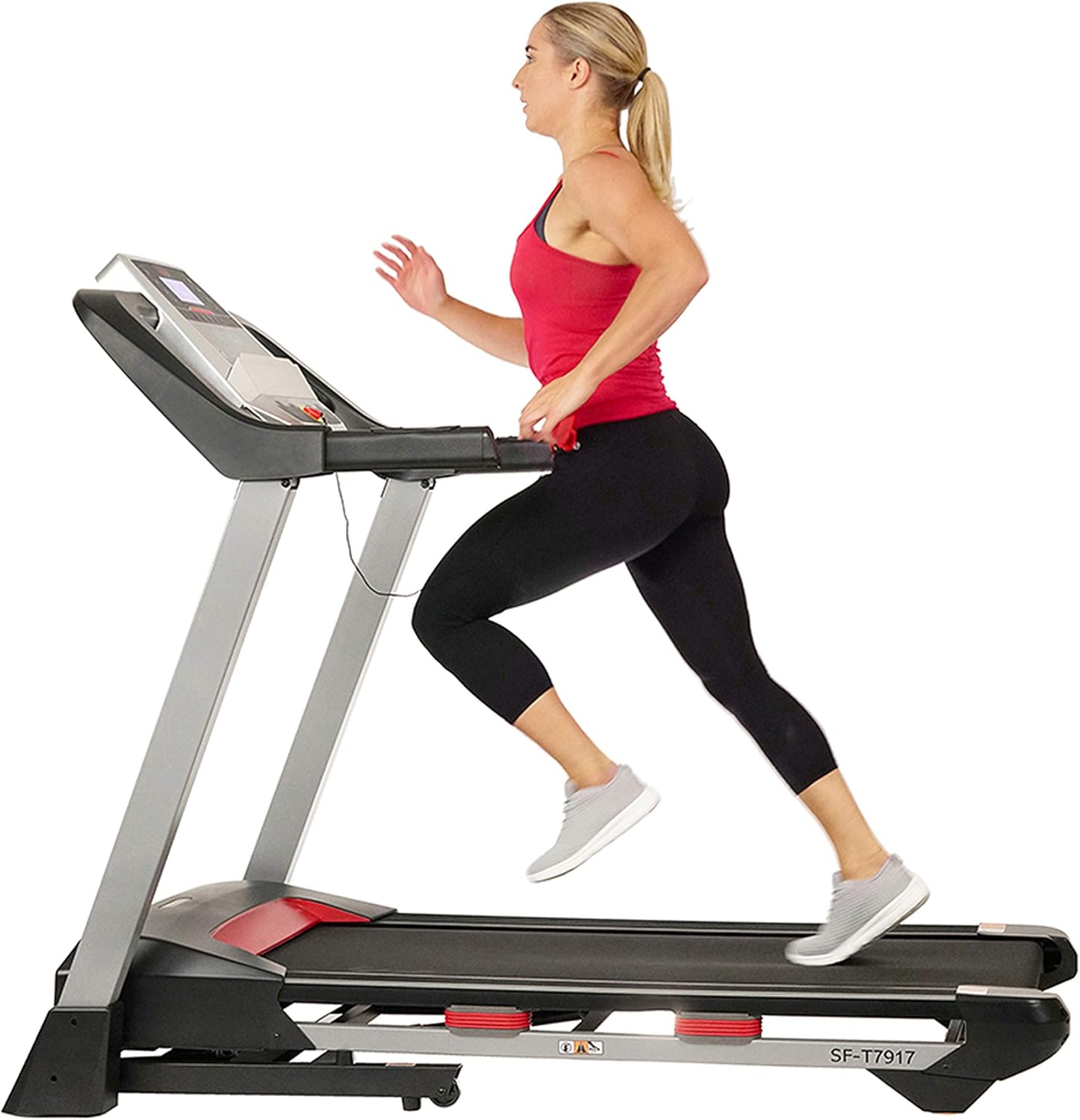


| Sunny Health & Fitness Performance Treadmill | Horizon Fitness 7.0 AT | UREVO Smart Walking Pad | NordicTrack T Series 10 |
| Best for: budget walking and jogging | Best for: running at home | Best for: walking at a standing desk | Best for: slow incline walking |
| ✅ Folds for storage | ✅ Buyers call it quiet and solid | ✅ Well rated by buyers | ✅ 12% incline, 325-lb capacity |
| ✅ 15 auto-incline levels | ✅ Works with training apps | ✅ Remote and app control | ✅ Low step-up height |
| ⚠️ Check weight limit and deck length | ⚠️ Fan reported as weak | ⚠️ Walking speeds only | ⚠️ Features need subscription |
| ⚠️ Check recent reviews for durability | ⚠️ Heavy to move | ⚠️ Compact deck | ⚠️ Some buyer complaints (noise, slow incline) |
| Evidence for this use: randomized trials | Evidence: systematic review, low to very low certainty | Evidence: modest, low certainty | Evidence: limited/early (lab studies + small short-term trials) |
No pick for extra deck cushioning to protect joints or prevent injury (section 5).
1. Best Treadmill for Home Weight Loss and Everyday Cardio: Sunny Health & Fitness Performance Treadmill
Evidence tier: Real support. Randomized trials, including one built around treadmill walking and jogging.
| Pros | Cons |
|---|---|
| Folds for storage, so it fits a small home | Check the listed weight limit and deck length against your size before buying |
| 15 levels of automatic incline for varied sessions | Not a model used in any study; check recent reviews for durability |
| Shock-absorbing deck, digital monitor and quick speed buttons | Connectivity is basic compared with subscription-based treadmills |
| Study: supervised treadmill walking and jogging was followed by 4.3–5.7% weight loss over 10 months in per-protocol completers | Folding treadmills are heavy to move; check the listed product weight |
Sunny Health & Fitness Performance Treadmill is a budget-priced folding treadmill with automatic incline, a shock-absorbing deck, a digital monitor, quick speed buttons and Bluetooth connectivity. It is here because the weight-loss evidence is mostly about how many minutes per week you spend on moderate-intensity aerobic exercise. A low-cost machine that gets used regularly can supply those minutes; that is my inference, not a trial finding. It is a class match, not the treadmill used in any study.
What buyers say about the Sunny Health & Fitness Performance Treadmill: buyer ratings were part of why it made the shortlist, but I make no claims here about specific review themes. Before you buy, read the most recent reviews for comments on durability, deck length and how it copes with frequent jogging.
The research. Weight loss has a large body of randomized-trial evidence. A 2024 dose-response meta-analysis pooled 116 randomized trials of supervised aerobic training, lasting at least 8 weeks, in 6,880 adults with overweight or obesity. Each additional 30 minutes per week of aerobic exercise was associated with 0.52 kg lower body weight, a 0.56 cm smaller waist and 0.37% lower body fat percentage. The authors concluded that at least 150 minutes per week at moderate intensity or higher may be needed for clinically important reductions in waist circumference and body fat[1].
One particularly treadmill-specific randomized trial is the Midwest Exercise Trial 2. Researchers randomized 141 sedentary young adults with overweight or obesity (average age 22.6, average BMI 31.0) to supervised exercise burning either 400 or 600 kcal per session, five days a week for 10 months, or to a non-exercise control group. Participants were instructed to keep eating as usual. Among those who completed at least 90% of sessions (per-protocol analysis), the exercise groups lost 3.9 kg (4.3%) and 5.2 kg (5.7%), while the control group gained 0.5 kg; the two exercise groups did not differ significantly[2]. The exercise consisted mainly of walking and jogging on motorized treadmills (other activities were allowed in up to 20% of sessions). In a later analysis of the same trial (92 participants who completed the intervention), absolute VO2max rose by 11.3% and 14% in the two exercise groups versus a 2.0% fall in controls, and the exercise groups did not differ significantly[3].
Two limits matter. Every session in that trial was supervised, so it does not show whether the same adherence or weight loss would occur with unsupervised home exercise. And the participants were young adults, so the size of the effect may differ in older people. The MET-2 trial did not test whether a particular brand, motor rating or feature changes the result. Across trials, more weekly aerobic exercise was associated with greater weight loss[1], and the trials did not compare treadmill price or features. Choosing an inexpensive folding machine here is therefore an editorial choice, not a trial finding. If you weigh more than the listed weight limit of a machine, choose a higher-capacity treadmill such as the one in section 4.
One point is worth keeping in mind when talking about treadmills for weight loss: in practice, exercise is usually only one part of the equation. I would be cautious about presenting a treadmill as a stand-alone weight-loss solution. Dietary intake often becomes just as important, while exercise can support the process in other ways.
In my clinical experience, I sometimes see the two reinforce each other. Once someone starts exercising regularly, they may become more motivated to pay attention to what they eat as well. I recognize the same mindset in myself: after a good workout, I am more inclined to eat in a way that supports the training rather than feeling that I have undone part of the effort with my diet. That is a personal way of thinking about it rather than a physiological rule, but it illustrates why exercise and diet can become linked in everyday behavior.
2. Best Treadmill for Home Runners: Horizon Fitness 7.0 AT
Evidence tier: Systematic-review evidence that treadmill running is largely comparable to overground running biomechanically; certainty mostly low to very low.
| Pros | Cons |
|---|---|
| Buyers describe it as quiet, smooth and solid | Fan reported as weak |
| Connects over Bluetooth to third-party training apps | Buyers report quick-dial controls are easy to bump |
| 12 mph top speed, 20″ × 60″ deck, 0–15% incline, folds | Heavy to move |
| Study: treadmill running mechanics are largely comparable to overground running | Buyers report quiet built-in speakers |
Horizon Fitness 7.0 AT is a mid-priced folding treadmill with a 12 mph top speed, a 60-inch deck, incline up to 15% and a 325-lb capacity. Its 12 mph top speed (about 19 km/h) covers the highest speed (18 km/h) used in the energy-cost study cited below. It is a class match, not a treadmill used in any study.
What buyers say about the Horizon Fitness 7.0 AT: comments found in owner and reviewer reports include that it runs quietly and smoothly, feels sturdy for a folding machine and pairs with apps such as Zwift or Peloton. Reported complaints include a weak fan, speed and incline dials that are easy to knock by accident, quiet speakers and an awkward power-button position. Its product weight is listed at roughly 250 lb or more (figures differ between manufacturer pages), so it is heavy to move even though it folds.
The research. The key question for runners is whether treadmill miles transfer to the road. A 2020 systematic review and meta-analysis of 33 crossover studies with 494 healthy adults, mostly runners or otherwise physically active, concluded that timing, joint motion, ground forces, muscle activity and tendon measures were largely comparable between motorized treadmill and overground running. Muscle-activity findings were conflicting, and ground contact was about 5 ms longer on the treadmill. The differences that did appear were mostly in the sagittal plane: the angle of the foot at landing (9.8° lower), knee flexion at landing (about 2.3° more flexed), the range of knee flexion from landing to peak stance (about 6.3° smaller), and how much the pelvis moves up and down. Peak push-off force was slightly lower on the treadmill than on a lab runway, while the overall vertical loading rate did not differ significantly. The review covered only level, non-cushioned treadmills. Most outcomes were rated very low to low certainty, and familiarization times in the literature ranged from 30 seconds to 9 minutes, with most studies reporting about 8 minutes and large individual differences. Four of the nine authors declared footwear-industry links (shoes donated for past projects, or paid footwear-related work), and the review states that no companies played a role in its design, conduct or interpretation[4].
Energy cost is the other half of the equation. Running indoors removes air resistance, which can lower the energy cost of level treadmill running compared with the road at the same speed. In a classic study of nine trained male runners at speeds between 2.92 and 5.0 m/s (about 10.5 to 18 km/h), a 1% treadmill grade best matched the oxygen cost of level outdoor road running in 6-minute runs at each speed (the authors’ conclusion refers to efforts of approximately 5 minutes)[5]. The sample was small and limited to trained men, and slower jogging was not tested. In that study, 1% was the grade that best matched the energy cost of level outdoor running at those speeds; at the two slowest speeds, 0% also did not differ significantly. A 2026 study of 12 male runners (8 to 15 km/h, 1% grade) found that overground running still cost more energy than treadmill running, and its authors concluded that the 1% correction does not fully replicate the energetic demands of overground running[21]. These newer data support treating 1% as a context-dependent approximation rather than a universal rule.
This is probably my favorite category. I personally enjoy training indoors at home, especially for running, because it removes a lot of the friction that can make exercise feel like a bigger project than it needs to be. There is no need to pack a bag, travel to a gym, or dress for the weather. You can simply step onto the treadmill and start.
For me, that “home-field advantage” matters. The threshold to train is very low, which makes the treadmill especially practical on days when time or motivation is limited. That convenience is one of the main reasons I like home running, although it is a personal preference rather than an argument that indoor running is inherently better than running outside.
3. Best Under-Desk Treadmill for Sitting Less at Work: UREVO Smart Walking Pad
Evidence tier: Real but modest. Trials and meta-analyses show more walking or less sitting, with low-certainty evidence; long-term health benefits are not established.
| Pros | Cons |
|---|---|
| Listing advertises quiet operation, suited to calls and shared spaces | Walking speeds only, not a machine for running |
| Double shock absorption for long walking sessions | Compact deck: check belt length against your stride |
| Remote and app control; plug and play with no assembly | Check the listed weight limit and motor rating before buying |
| Study: treadmill workstations raised weekday walking by about 18 minutes versus 1 minute in controls over 13 months | Not a model used in any study (class match only) |
UREVO Smart Walking Pad is a compact under-desk walking pad with double shock absorption, remote and app control, a workout app with a MIIT mode and plug-and-play setup. It is here because the studied benefit comes from slow walking during desk work, which needs a quiet, low-profile machine rather than a full treadmill. It is a class match: the trial used office treadmill workstations, not a consumer walking pad.
What buyers say about the UREVO Smart Walking Pad: ratings were good across several hundred reviews at the time of writing. Before you buy, read the most recent reviews on the listing for comments on belt length, noise at your walking speed and motor strength for your body weight.
The research. A Swedish randomized trial enrolled 80 office workers aged 40 to 67 with overweight or obesity (BMI 25 to 40). Half were given treadmill workstations to use as they chose, plus reminder emails; the other half kept their sit-stand desks. Over 13 months, weekday walking time rose by 18 minutes in the treadmill group versus 1 minute in the control group (difference 22 minutes, 95% CI 7 to 37). The increase was statistically significant but smaller than the 30-minute difference the researchers had set as their primary target, so the trial did not meet its primary outcome. Weekend walking did not differ between groups. The study was funded by Umeå University, the Västerbotten County Council and the Mayo Clinic Foundation for Research[6].
A 2018 Cochrane review of workplace interventions found that active workstations as a group, treadmill and cycling desks, had unclear or inconsistent effects on sitting time, although treadmill desks combined with counselling seemed to reduce sitting at work, based on one small trial (31 participants, low-certainty evidence) over the short term[7].
More recent pooled analyses point the same way. A 2021 meta-analysis of 13 treadmill-desk studies (351 participants; seven laboratory and six workplace studies) found that, in laboratory studies, a treadmill desk raised energy expenditure by 105.23 kcal per hour (95% CI 90.41 to 120.4) compared with sitting. In workplace studies it reduced sitting time (mean difference −1.73 minutes per hour over 24 hours, 95% CI −3.30 to −0.17), with no significant changes in other metabolic outcomes[17]. A 2023 network meta-analysis of 23 randomized trials of several active-workstation strategies in 1,428 office workers estimated that treadmill workstations combined with promotion reduced work-specific sitting time (standardized mean difference −1.29, 95% CI −2.51 to −0.07); the overall certainty of the evidence was described as low[18].
Taken together, controlled and pooled studies support more walking or less sitting, while the studies cited here do not establish a long-term benefit for body weight or metabolic health. A one-year study of 36 volunteers who switched to treadmill desks (no control group is described in its abstract) reported an average weight loss of 1.4 ± 3.3 kg, with no significant change in fat mass in the group overall; without a control group, it cannot show that the desks caused the change[22]. In practice, actual use is also likely to matter; that is a practical inference rather than a trial finding.
This category is particularly useful if you work from home. I have used a walking pad from time to time myself, and I can see the appeal for remote work: it lets you add some movement to the day without turning it into a separate workout session.
Personally, I prefer a fairly slow walking pace when I am working. Faster is not necessarily better in this setting, because the main goal is still to be able to concentrate on the task in front of you. I also find that I still need to sit down periodically. Even if you are moving rather than standing still, spending a long time in the same basic working setup can still become uncomfortable, and I sometimes notice tension around the gluteal area after prolonged use.
One practical limitation is that many walking pads are built primarily for walking rather than proper running. They are usually lighter and more compact than full-size treadmills, which is exactly what makes them convenient under a desk, but it also means I would not choose one if my main goal were to run a full training session at home.
4. Best Treadmill for Home Incline Walking and Early-Stance Knee Load: NordicTrack T Series 10
Evidence tier: Limited/early. Small lab studies and two small, short-term clinical trials in knee osteoarthritis, plus a 2026 incline-versus-flat study whose results I have not assessed; I did not identify comparative trials longer than eight weeks on pain or weight outcomes.
| Pros | Cons |
|---|---|
| 12% incline and 325-lb capacity | Many features require a paid iFIT membership |
| Low step-up height (about 8 inches) | Some buyer complaints across retailers |
| Buyers mention a sturdy build, quiet running and an assisted fold | Buyers report the incline is slow to reach its top setting and noisier than the belt |
| Study: slow uphill walking cut early-stance peak knee compressive force by 23% versus brisk level walking in adults with obesity (lab) | Some buyers report stuttering at the very lowest speeds; small screen |
NordicTrack T Series 10 is a folding treadmill with a 0–12% incline, 12 mph top speed, 20″ × 60″ deck, 325-lb capacity and a step-up height of about eight inches. It is here because its 12% maximum incline covers the grade of the knee-loading lab study below (6 degrees, about 10.5%) and the 12% used in 12-3-30, though not the steeper 8-degree (about 14%) slope used in the knee osteoarthritis trial, and it lists a 325-lb user capacity; about half of the knee-loading study sample (9 of 19) had obesity. It is a class match, not a model used in any study.
What buyers say about the NordicTrack T Series 10: comments found in buyer and reviewer reports include a solid frame, quiet operation, workouts that change speed and incline automatically and a fold that saves space. Reported complaints include that much of the experience sits behind an iFIT subscription, the incline takes a while to climb and is noisier than the belt, the 10-inch screen feels small, and the belt stutters at the very lowest speeds for a few owners. Reviewers also describe assembly as a two-person job because of its weight.
The research. The knee question has the most direct data. In a lab study of 9 adults with moderate obesity and 10 without obesity walking on an instrumented treadmill, slow uphill walking (0.75 m/s on a 6-degree slope; about 1.7 mph and a roughly 10.5% grade when converted) was compared with brisk level walking (1.50 m/s, about 3.4 mph). Peak tibiofemoral (knee) compressive force in early stance fell by 23% in the participants with obesity and by 35% in those without. Late-stance peak forces were similar in both conditions[8]. These forces were estimated with a musculoskeletal model in a laboratory setting. The study measured forces, not knee pain, arthritis progression or injury.
Clinical data are thinner. In a small randomized trial of 30 adults aged 40 to 65 with moderate knee osteoarthritis, both groups had 10 physiotherapy sessions and the intervention group also walked uphill on a treadmill (8-degree incline, 1.1 m/s, 30 minutes per session). Both groups improved in daily activities and quality of life. The authors reported that the uphill group improved additionally in pain, symptoms and sports function (measured with the Persian version of the Knee injury and Osteoarthritis Outcome Score), sustained at a 20-day follow-up, and concluded that physiotherapy combined with uphill walking, versus physiotherapy alone, resulted in improvements in pain, other symptoms and sports function[19].
A second, separate randomized trial published in 2025 enrolled 36 adults aged 50 to 60 with grade II to III knee osteoarthritis. Both groups received standard therapy (strengthening exercise and TENS); the treatment group also did uphill treadmill walking (8 degrees, 1.1 m/s, 30 minutes, twice a week for 5 weeks). Walking speed on a 10-meter walk test showed significant improvements after treatment (p = 0.030) and at a 20-day follow-up (p = 0.02)[23]. In both trials the uphill group did additional exercise and there was no level-walking comparison, so neither can show that incline walking works better than level walking, and 20 days is a short follow-up.
The popular “12-3-30” workout (12% incline, 3 mph, 30 minutes)[9] has been examined in at least two small lab studies. A 2024 study of 17 participants described the physiological responses to the workout, with an average energy expenditure of 220.8 ± 49.7 kcal per workout and an average heart rate of 124.2 ± 17.9 beats per minute[16]. A 2025 exploratory study enrolled 16 recreationally active adults (mean age about 25; 14 in the final paired analysis) and compared 12-3-30 with self-paced treadmill running at the same total energy expenditure. 12-3-30 took longer to burn the same energy, burned it at a lower rate, and drew a larger share of that energy from fat[9]. This acute study did not test whether the higher proportion of fat oxidation translated into greater body-fat loss over time. Across trials, weight and fat measures decreased with increasing weekly aerobic exercise duration, up to 300 minutes per week[1].
So the case for incline walking is plausible but still limited: acute lab studies of knee loading and energy use, plus two small clinical trials in people with knee osteoarthritis that I identified, each with about 20 days of follow-up. A 2026 study compared eight weeks of incline and flat treadmill walking in middle-aged women with obesity, measuring body composition and cardiorespiratory function[24]; I have not assessed its results. I did not identify a comparative trial longer than eight weeks showing that regular incline walking reduces knee pain or improves weight loss more than level walking.
What I like most about incline walking is that it genuinely feels more demanding. You are working against gravity rather than simply moving forward on a flat surface, so even at a relatively modest speed the effort can rise quickly.
From my own experience, the muscular demand also feels noticeably different. I tend to feel more work through the calves and the gluteus maximus when the incline increases, which is one of the reasons I find uphill walking more interesting than simply increasing speed on a flat treadmill. That is a subjective training observation rather than a claim about how much any specific muscle is activated, but the change in how the movement feels is very noticeable in practice.
5. Best Cushioned Treadmill for Protecting Joints and Preventing Injury
Evidence tier: No controlled outcome trial identified. I did not identify a controlled trial showing that a more cushioned treadmill deck reduces injuries or joint pain.
Why there’s no pick: Cushioning changes how the deck feels, and it does reduce some forces in the lab. But I did not identify a controlled study showing that it lowers injury rates or joint pain, and runners can adjust their own leg stiffness to the surface in small experiments. Choose cushioning for comfort if you like, not as a medical reason to pay more for a home treadmill.
The evidence. Treadmill makers often market deck cushioning as joint protection. SOLE says on its own site that its Cushion Flex Whisper Deck “reduces impact by up to 40%” compared with running on asphalt, and that cushioned treadmills “decrease the likelihood of impact-related injuries”[20]. I did not find independent outcome evidence behind either claim. The independent data are narrower. In a lab study of 20 men running at 8 and 10 km/h, a cushioned treadmill reduced peak force under the forefoot at both speeds and under the midfoot at the faster speed, but did not decrease impact force on the rear foot. It also increased metabolic energy consumption. The authors suggested cushioned decks may help prevent forefoot injuries, but the study did not measure injuries[10].
Runners may also compensate. In a six-person experiment on rubber track surfaces (not a treadmill-cushioning trial), runners at 3 m/s crossed from a soft to a hard surface they knew was coming and adjusted their leg stiffness on the very first step, keeping the up-and-down motion of their body nearly constant[11]. Whether impact forces cause injury is less settled than the marketing suggests. A systematic review and meta-analysis of 18 studies found no difference in vertical impact peaks between injured and uninjured runners. Loading rates were higher in runners with a history of stress fractures and in pooled all-injury groups, but prospective studies on other injury types were absent, so no firm conclusions on loading rate were possible[12]. In the pooled data, non-cushioned treadmills did not differ significantly from overground running in average vertical loading rate (low certainty)[4].
At first glance, it makes intuitive sense that a more cushioned treadmill could change how running feels. The foot–ankle–Achilles complex already behaves partly like an elastic spring, storing and returning energy with each step. If the running surface adds another compliant layer underneath that system, some of the mechanical energy may be absorbed by the surface rather than returned in exactly the same way.
That is also how I tend to think about the higher energy cost reported with cushioned treadmill running: adding compliance may make the overall system slightly less mechanically efficient. It is an interesting physiological explanation, but I would separate it from the much stronger claim that cushioning protects joints or prevents injuries. A surface can feel softer and alter forces or energy expenditure without necessarily producing a clinically meaningful reduction in pain or injury risk.
Quick Comparison
This best treadmill for home table is a navigation aid, not a ranking. Each pick answers a different question, and the evidence behind each section differs in strength.
| Section | Use case | Evidence tier | Pick |
|---|---|---|---|
| 1 | Weight loss and everyday cardio | Randomized trials (for this use, not for the product) | Sunny Health & Fitness Performance Treadmill |
| 2 | Running at home | Systematic-review evidence, low to very low certainty | Horizon Fitness 7.0 AT |
| 3 | Walking at a standing desk | Modest, low certainty (more walking or less sitting, health benefits not established) | UREVO Smart Walking Pad |
| 4 | Slow incline walking and early-stance knee load | Limited/early (lab studies + small short-term trials) | NordicTrack T Series 10 |
| 5 | Extra cushioning to protect joints | No controlled outcome trial identified | No pick |
FAQ
Is treadmill running biomechanically similar to running outside? Largely, under the conditions studied (level, non-cushioned treadmills). Running mechanics are largely comparable, with some differences in foot angle and knee motion[4], and in one small study of nine trained male runners at 2.92–5.0 m/s, a 1% treadmill grade most closely reproduced the energy cost of level outdoor running[5], although a 2026 study of 12 male runners found that overground running still cost more energy than treadmill running at 1%[21]. Familiarization time varied considerably between runners in the treadmill-versus-overground review cited above, so treadmill mechanics may not feel settled immediately. The Horizon Fitness 7.0 AT lists a 60-inch deck and a 12 mph top speed, a broad range for home running; suitability depends on your size, stride and training speeds.
How much treadmill time do I need to lose weight? In the pooled trials, at least 150 minutes per week of moderate or harder supervised aerobic exercise was associated with clinically important reductions in waist circumference and body fat[1]. A budget machine such as the Sunny Health & Fitness Performance Treadmill can supply those minutes if you use it consistently, though the trials tested exercise volume, not treadmill price tiers; that is a practical inference, not a trial finding.
Are walking pads safe? In April 2026 the U.S. Consumer Product Safety Commission told consumers to stop using Sperax walking pads and treadmills (models Pro, Q1, RM-01 and RM-02) because of sudden speed changes that caused falls and overheating that created fire and burn hazards, after the importer refused an acceptable recall[13]. The warning named four specific models; search cpsc.gov for any model you are considering.
Are treadmills safe in a home with small children? They need the same respect as any heavy machinery. In a 2016 hospital news release on a retrospective review of 2010–2014 cases at a regional pediatric burn center, treadmills were the second leading cause of hand burns, usually from a child’s hand getting caught in the moving belt, and these friction burns needed longer care than other contact hand burns (51 days versus 11 days). The study’s authors recommend baby gates or play pens, never leaving a running treadmill unattended and learning its safety mechanisms[14]. Follow the manufacturer’s instructions for the safety key.
Will walking at my desk hurt my work? Possibly little, though the evidence is thin. A systematic review of seven studies stated that active workstations “do not appear to decrease workplace performance,” but it also noted that some treadmill- and cycling-workstation studies identified potential decreases in performance and that many studies lacked the power to detect differences. Three longer studies (12 to 52 weeks) reported no significant effect on productivity[15]. The review also noted that walking was a hindrance to mouse-related tasks such as typing, possibly because such tasks need a steady posture and precise use of the hands. If walking interferes with detailed mouse or typing work, slow down or pause on a UREVO Smart Walking Pad or any other walking pad; that is my practical advice, not the review’s recommendation.
What This Means for Buyers
Here is the short version of how to choose the best treadmill for home use:
- Weight loss and everyday cardio (randomized trials on exercise, not on products): The cited evidence is about aerobic exercise volume, not treadmill features. The Sunny Health & Fitness Performance Treadmill is an inexpensive folding machine with auto incline for brisk walking and jogging. In the pooled trials of adults with overweight or obesity, 150 minutes per week or more of moderate-or-harder exercise was the level associated with clinically important waist and body-fat changes; that is not a general recommendation for every buyer. Check its listed weight limit.
- Running at home (systematic-review evidence, low to very low certainty): Treadmill running is largely comparable to overground running. The Horizon Fitness 7.0 AT has the speed, deck length and incline for structured sessions. In one small study, a 1% incline best matched the energy cost of level outdoor running in trained men at roughly 10.5–18 km/h; a 2026 study found that 1% did not fully match overground cost, so treat it as approximate.
- Sitting less at work (real but modest): Expect a modest bump in walking time, not a guaranteed health payoff. The UREVO Smart Walking Pad is compact and made for slow walking, but it is walking-only and the deck is compact.
- Incline walking and knee load (limited/early): Slow uphill walking lowered early-stance peak knee compressive forces in the lab (late-stance peaks were unchanged), and two small trials in knee osteoarthritis reported additional improvements when uphill walking was added to other therapy (one in pain, symptoms and sports function; the other in 10-meter walking speed), with follow-up of about 20 days, but the comparators differed and I did not identify comparative trials longer than eight weeks. The NordicTrack T Series 10 covers the grade of the lab study and lists a 325-lb capacity, with some buyer complaints and a subscription-heavy console.
- Extra cushioning for joint protection (no controlled injury or pain outcome evidence identified): No pick. Cushioning is a comfort choice, not demonstrated injury prevention.
Personally, the broader reason I like home exercise equipment is the extra degree of freedom it gives you. You can train when it suits you rather than planning around gym opening hours, and indoor exercise is not dependent on the weather. There is also less friction: no packing a bag, changing for the trip, or spending time travelling back and forth.
That flexibility becomes even more useful with a walking pad, because movement can sometimes be combined with work rather than requiring a completely separate training block. I would not treat that as a replacement for every other form of exercise, but from a practical standpoint it can make physical activity easier to fit into a busy day. For me, that convenience is one of the strongest arguments for having exercise equipment at home.
References
- https://pmc.ncbi.nlm.nih.gov/articles/PMC11672165/
- https://kuscholarworks.ku.edu/entities/publication/8a49300c-f44c-4cea-b166-77070386bde7
- https://ttu-ir.tdl.org/items/eb7d6421-518b-4511-8238-814704ab2edb
- https://link.springer.com/article/10.1007/s40279-019-01237-z
- https://pubmed.ncbi.nlm.nih.gov/8887211/
- https://doaj.org/article/3743e688d9b5463590b9c153c3750952
- https://doi.org/10.1002/14651858.CD010912.pub5
- https://experts.nau.edu/en/publications/a-comparison-of-slow-uphill-and-fast-level-walking-on-lower-extre/
- https://digitalcommons.wku.edu/ijes/vol18/iss6/1
- https://pubmed.ncbi.nlm.nih.gov/30682642/
- https://pubmed.ncbi.nlm.nih.gov/10433420/
- https://bjsm.bmj.com/content/50/8/450
- https://cpsc.gov/Warnings/2026/CPSC-Warns-Consumers-to-Stop-Using-Sperax-Walking-Pads-and-Treadmills-Immediately-Due-to-Risk-of-Serious-Injury-from-Fall-Burn-and-Fire-Hazards
- https://www.nationwidechildrens.org/newsroom/news-releases/2016/10/new-study-finds-exercise-treadmills-significant-cause-of-hand-burns-in-children
- https://www.mdpi.com/1660-4601/15/3/417
- https://ijrep.org/physiological-responses-of-the-12-3-30-workout-exercise-myth-or-reality/
- https://bmcpublichealth.biomedcentral.com/articles/10.1186/s12889-021-12094-9
- https://link.springer.com/article/10.1186/s12966-023-01467-5
- https://ptj.uswr.ac.ir/article-1-407-en.html
- https://soletreadmills.com/blogs/news/best-cushioned-treadmills-for-shock-absorbing-exercise-2024
- https://journals.plos.org/plosone/article?id=10.1371/journal.pone.0355988
- https://doi.org/10.1002/oby.20121
- https://ptji.org/index.php/ptji/article/view/277
- https://doi.org/10.23949/kjpe.2026.5.65.3.22




