Best Knee Brace for Kneecap Pain: What the Research Actually Supports (and What It Doesn’t)

Table of Contents
Introduction: Best Knee Brace for Kneecap Pain
Kneecap pain is a common reason people end up seeking medical advice, and the cause can vary considerably. Sometimes it follows a clear injury or accident; in other cases, symptoms appear after repetitive loading, gym training, or an overuse problem such as patellar tendinopathy. In my clinical experience, patients also quite often arrive with some type of knee support already in use—frequently a simple neoprene sleeve—and one of the first questions is whether the brace is actually doing anything useful.
The answer depends heavily on what is causing the pain. A basic neoprene sleeve may provide warmth, a sense of support, and some proprioceptive feedback, but it is quite different from a brace designed to influence patellar position or provide more targeted mechanical support. This is an important distinction because “kneecap pain” is not a single diagnosis. It can describe patellofemoral pain, a tendon problem such as jumper’s knee, or an acute structural injury such as patellar dislocation, and the evidence for bracing does not transfer neatly from one condition to another.
This is also how I tend to think about knee braces in practice: there is no universal brace that makes sense for every type of anterior knee pain. The useful question is not simply “What is the best knee brace for kneecap pain?” but rather “Which type of brace, if any, makes sense for this particular problem?” That is why I put this comparison together. Below, I look at the main kneecap-related conditions separately, including where research supports bracing, where the evidence is weak, and where a brace may add little beyond other forms of management. This is the companion piece to Best Knee Brace for ACL and Arthritis, which focuses on ligament injuries and osteoarthritis rather than conditions centered more specifically around the patella and its surrounding structures.
Some of the links on this site are affiliate links. If you purchase a product through these links, I may earn a commission. This doesn’t cost you anything, but it helps me maintain this page so I can continue to share free information with the world. As an Amazon Associate, I earn from qualifying purchases. Product links are provided for informational and convenience purposes only. Their inclusion does not constitute medical or nutritional advice or a personalized recommendation.
Best Knee Brace for Patellar Tendinopathy (Jumper’s Knee)
Patellar tendinopathy — pain in the tendon just below the kneecap, common in jumping and change-of-direction sports — is a distinct diagnosis from patellofemoral pain syndrome (PFPS), even though the two are frequently confused in casual conversation and product marketing.
Cho-Pat Dual Action Knee Strap

Why it’s here: this is an infrapatellar strap — the product category directly studied for symptomatic relief during loading activities — and it’s also the specific brand tested by name (alongside a second brand) in the biomechanical strain study cited below, a stronger evidence link than a generic category match. Cho-Pat has been used as a knee-support brand for decades, per the manufacturer.
| Pros | Applies targeted compression below (and in the Dual Action version, above) the kneecap rather than compressing the whole joint; several reviewers describe real relief during stair climbing and standing from a chair; low-profile enough to wear under clothing |
| Cons | Study: reduces pain during loading activity — it does not heal the underlying tendon pathology itself; at least one detailed review reported a skin rash/irritation reaction where the strap sits behind the knee, apparently from reduced airflow combined with sweat; sizing runs by knee circumference and needs to be measured carefully |
What buyers say about the Cho-Pat Dual Action Knee Strap: Feedback on infrapatellar straps in this style skews positive for the core promise — several users describe being able to walk, climb stairs, and get up from chairs with meaningfully less pain than without the strap. A recurring complaint across a minority of reviews is skin irritation or a rash where the strap contacts skin behind the knee during extended wear, which is worth knowing about if you have sensitive skin.
What the research shows: A systematic review identified four relevant studies on infrapatellar strap use for patellar tendinopathy (one at a higher level of evidence, three at a lower level) and found three of the four studies showed a significant decrease in pain during jumping activities while wearing the strap.[1] A separate controlled laboratory study using radiographic measurements and a computational model tested the Cho-Pat strap specifically (alongside a second brand) in 20 healthy adult men (not diagnosed with tendinopathy) and found that in the majority of participants, the strap altered the patella–patellar tendon angle and reduced patellar tendon length in a way that decreased calculated (not directly measured) strain at the specific tendon location involved in jumper’s knee — a small number of participants showed no measurable change, for reasons the study couldn’t fully explain.[2] This is a biomechanical finding about predicted tendon strain, not a clinical measurement of pain or healing in people who actually have tendinopathy — worth keeping distinct from the pain-outcome evidence in refs [1] and [3]. A small pre-/post-test study in 16 young athletes (ages 12–18) with diagnosed patellar tendinopathy found reduced pain during three of four jumping tests (drop jump, single-leg jump, and a 30-second jump test) while wearing an infrapatellar strap, without a reduction in jump performance.[3] A larger randomized trial in 97 athletes with patellar tendinopathy found a patellar strap significantly reduced pain during a single-leg decline squat compared with a no-support control (14mm reduction on a 100mm scale, P=.04) — but the strap wasn’t significantly better than a placebo tape condition, suggesting at least part of the short-term benefit may be nonspecific rather than mechanism-specific.[4] Worth being direct about: this is symptomatic, in-the-moment pain relief during loading, not a treatment that has been shown to resolve the underlying tendon pathology — the strap doesn’t substitute for the loading-based rehabilitation that actually addresses tendinopathy over time.
Patellar tendinopathy, or jumper’s knee, is a relatively common overuse problem, particularly in athletes exposed to repeated jumping and landing. In my clinical experience, I have encountered it especially often in basketball players, which also makes the term “jumper’s knee” quite intuitive. The symptoms can sometimes be surprisingly persistent, and these cases are not always quick or straightforward to manage.
It is therefore worth remembering that a knee strap is mainly a symptom-management tool rather than the whole treatment. In practice, rehabilitation can become an important part of recovery, often with physiotherapy and a structured tendon-loading program. Eccentric exercise is one approach commonly used in this context. This is also why I would be cautious about judging a brace simply by whether it makes the knee feel better during activity—the more important question is whether the underlying tendon is also being rehabilitated appropriately over time.
Best Knee Brace for Preventing Patellofemoral Pain
This category is specifically about using a brace before patellofemoral pain (PFPS) develops — not treating pain that’s already present, which is a different question addressed further down.
Mueller Sports Medicine Patella Stabilizer Knee Brace

Why it’s here: this is a patella-supporting brace with an open padded patellar buttress and steel spring stays on both sides, marketed specifically for patella-tracking issues — a reasonable category-level approximation of the “patellofemoral braces” tested in the cited prevention trials, though mechanically different from both devices actually studied: the larger trial used the dynamic On-Track System, while the smaller trial used a brace with a silicone patellar support ring. The two underlying trials specifically used a dynamic patellofemoral brace (the On-Track System, dj Orthopedics) in 167 military recruits,[6] and a brace with a silicone patellar support ring in 60 young athletes[7] — this Mueller model wasn’t the device studied in either trial, so this remains a category-level match rather than a device-specific one, same as any other pick in this category would be.
| Pros | Meta-analysis-level evidence (not just a single trial) supports a real risk reduction for this general brace category; steel stays plus an open patella design add stability during activity, which is broadly the mechanism the prevention research is about; Mueller has made sports-medicine braces since 1959, and buyer feedback (below) is substantial and largely positive |
| Cons | Study: certainty of evidence is graded low (small trial count, wide confidence interval); Study: this Mueller model wasn’t the specific device studied — the trials used a dynamic patellofemoral brace and a silicone-patellar-ring brace, both mechanically different products from this one; population studied was mostly military recruits and young athletes — generalization to other populations (e.g., older recreational exercisers) is less certain; several reviewers note it runs small, so sizing up may be worth considering |
What buyers say about the Mueller Sports Medicine Patella Stabilizer Knee Brace: Feedback skews positive overall — buyers describe decent support and good value, with specific mentions of the brace stabilizing a painful or previously-injured knee and being comfortable for extended wear. The most consistent complaint is sizing: multiple reviewers note the brace runs a bit small relative to the printed measurements, so checking the size chart carefully (or sizing up if between sizes) is worth flagging to readers.
What the research shows: A systematic review and meta-analysis of randomized controlled trials pooled two trials (227 participants total) and found low-certainty evidence that patellofemoral braces worn during physical activity reduced the risk of developing patellofemoral pain by 60%, compared with no brace (risk ratio 0.40, 95% CI 0.22–0.73, I²=24%).[5] A separate single trial in the same review also found low-certainty evidence that running-technique retraining to “run softer” reduced patellofemoral pain risk (RR 0.21, 95% CI 0.07–0.60) — this wasn’t a head-to-head comparison against bracing, so it shouldn’t be read as bracing and retraining being directly compared, only that both showed a risk reduction in their own separate trials.[5] The same review found that multicomponent strengthening/neuromuscular exercise programs and foot orthoses did not significantly reduce risk in their own pooled analyses.[5] Worth naming the specific limitation plainly rather than a vague hedge: “low certainty” here reflects a small number of pooled trials, not a large or heterogeneous evidence base — this is real trial-level evidence, but from a thin base that a single well-designed future trial could meaningfully shift.
From a clinical perspective, prevention is a slightly difficult category because it is not always possible to predict when patellofemoral pain is going to appear. This becomes more relevant in athletes who have had similar symptoms before and already know that certain types of training or increases in load tend to provoke their knee.
In those situations, a brace can sometimes be considered proactively rather than waiting until symptoms are already established. I would still place much more emphasis on appropriate rehabilitation and physiotherapy, particularly when there is a history of recurring knee pain, but a brace may have a role as an additional tool rather than the main strategy. That distinction is important here: the potential value of preventive bracing does not mean that the underlying contributors to the problem can simply be ignored.
If a Brace Is Used After Patellar Dislocation
This is about conservative (non-surgical) management immediately after a first-time patellar dislocation or subluxation — a structurally different event from PFPS, even though both involve the kneecap. Worth stating upfront: a recent formal European consensus on this question does not find any brace superior to using no brace at all — this section is about which type of brace is preferable if one is used, not a claim that bracing itself is proven necessary.
DonJoy Tru-Pull Lite Knee Brace
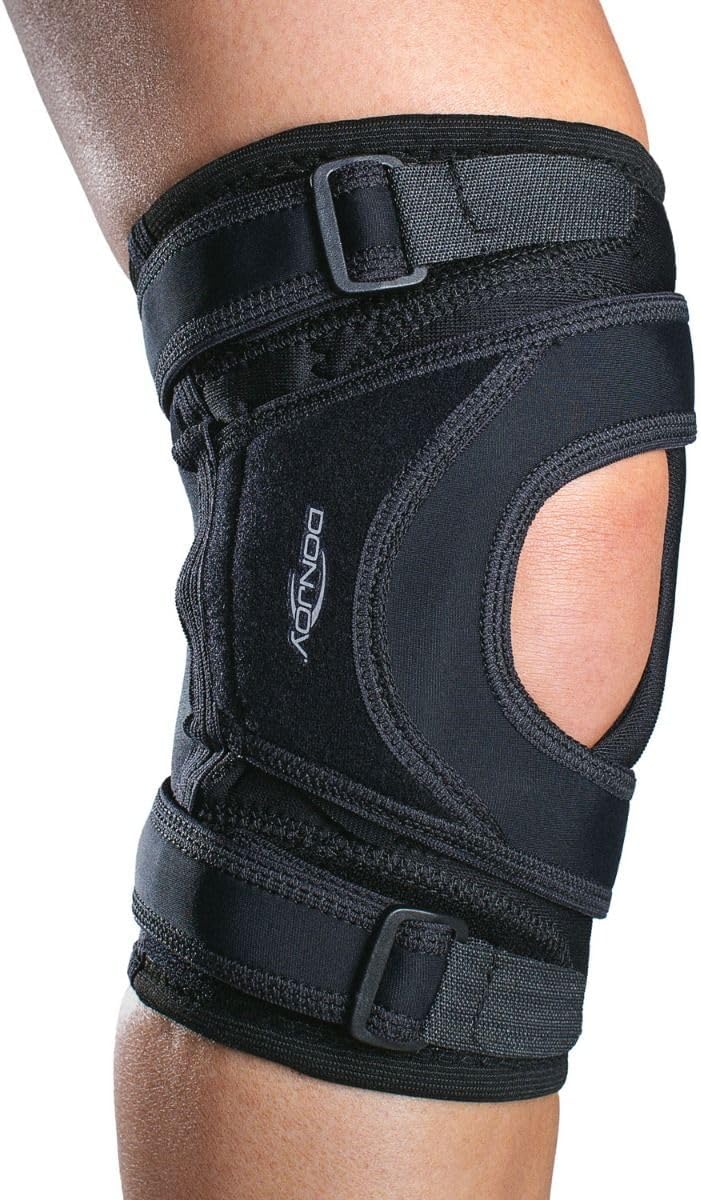
Why it’s here: this is a low-profile, motion-permitting patella-realignment brace with removable hinges — placing it in the less-restrictive category that the largest trial below associated with better early function, rather than a claim that this specific model was used in the cited trials or that current guidance recommends this device over not bracing at all.
| Pros | Allows knee motion rather than fully immobilizing the joint, consistent with what the largest trial below associates with better early functional outcomes; bifurcated pull straps allow adjustable medial/lateral correction; low-profile enough for daily wear during the early recovery weeks |
| Cons | Study: current European consensus guidance (2025) states bracing offers no clear long-term benefit after first-time patellar dislocation — this section covers brace-type selection, not evidence that bracing itself is necessary; Study: evidence quality across the older comparative studies below is rated low overall (older studies, small samples, heterogeneous brace designs), and it’s genuinely mixed rather than pointing one direction; Study: a functional/hinged brace has not been shown to reduce the rate of a second dislocation compared with a different brace design, and older data on rigid immobilization actually found a brace associated with more redislocations than a cast or splint — the older research supports less-restrictive bracing for early range of motion and quadriceps muscle preservation, not for preventing redislocation itself |
What buyers say about the DonJoy Tru-Pull Lite Knee Brace: Feedback is substantial and skews positive — the Large/Right-leg listing alone carries over 1,000 ratings averaging 4.0 out of 5 stars, and it’s a current Amazon best-seller in its category. Reviewers describe the brace as low-profile and comfortable for daily wear, with the corrective pull noticeably reducing kneecap-tracking pain during activity. The most common practical point buyers flag: this brace is asymmetrical and handed — you need to order specifically for your left or right knee (and the correct size), not a generic one-size product, so double-checking the exact listing before ordering matters more than with a simple sleeve.
What the research shows: A 2025 formal consensus from the European Society for Sports Traumatology, Knee Surgery and Arthroscopy (ESSKA), based on structured expert agreement across European orthopedic surgeons, concluded that physical therapy is an essential complement to treatment after first-time patellar dislocation, but bracing offers no clear long-term benefit.[8] This recent formal European consensus provides the clearest current guidance on bracing after first-time patellar dislocation, and it should be read as the primary takeaway before the older, more heterogeneous trial data below. A randomized trial of 79 patients compared a patella-stabilizing, motion-restricting brace (hinged to allow 0°–30° of motion) against a simpler neoprene non-hinged brace after first-time traumatic patellar dislocation, and found no statistically significant difference in redislocation rate at 3 years (34.4% vs. 37.5%; risk difference −3.1%, 95% CI −26.6% to 20.3%; the trial was underpowered to detect more modest differences).[9] The more restrictive brace was associated with quadriceps muscle atrophy, less knee range of motion, and worse functional outcomes in the first 6 months — at 6 months, the less-restrictive neoprene group scored significantly better on the Kujala function score (mean difference 4.6, P=.012), though the authors note this difference wasn’t considered clinically relevant by 3 years.[9] Older comparative data (reported via a 2012 systematic review of the literature) found a significantly higher redislocation rate per follow-up year with a brace (0.29) than with a cylinder cast (0.12) or posterior splint (0.08) — though this compared brace against cast/splint rather than against no immobilization at all, used older-style straps and sleeves rather than modern hinged designs, and the review itself rates the evidence as low quality given the small sample.[10] Separately, a randomized trial of 18 patients found that tape-bandage immobilization produced significantly better Lysholm function scores than cylinder-cast immobilization at 6 weeks, 12 weeks, and 5-year follow-up, with no cases of redislocation in either group in this small sample.[11] Taken together, this is a genuinely mixed and thin evidence base, not a unified one: the current expert consensus doesn’t find bracing beneficial long-term; the largest, most recent individual trial found less-restrictive bracing associated with better early function without a difference in redislocation risk; the oldest data actually points the opposite direction on redislocation specifically (higher rate with a brace than with rigid cast/splint immobilization, using older brace designs); and taping outperformed a cast on function with no redislocations in a very small sample. Current evidence does not establish a single best approach for preventing a second dislocation, and doesn’t clearly establish that bracing at all is necessary — if a brace is used, a less restrictive design may support better early range of motion and function than a more restrictive one, but that’s a different and narrower claim than “bracing helps.”
After a patellar dislocation, many patients end up using some type of knee brace, especially during the early phase of recovery. In my clinical experience, the brace can provide a sense of stability and confidence when the knee still feels vulnerable. That can be useful, but it is important not to confuse that feeling of support with rehabilitation itself. A brace does not replace active recovery and physiotherapy.
I also think a first-time patellar dislocation is something that warrants a proper medical assessment rather than being managed entirely on your own. Depending on the circumstances, imaging may also become relevant to assess the knee more carefully. From a clinical perspective, the important point is not simply choosing a brace, but first making sure the injury has been properly evaluated and then using the brace, if appropriate, as one part of the broader recovery process.
No Knee Brace Pick: Existing Patellofemoral Pain
This is a case where existing evidence doesn’t support a product recommendation — a different question from the prevention category above, which showed real (if thin) benefit.
Why there’s no pick here: a Cochrane systematic review identified five trials (368 adults with PFPS total, all rated very low quality and at high risk of bias) evaluating knee orthoses (braces, sleeves, straps, or bandages) for treating existing patellofemoral pain.[12] All five trials compared wearing a knee orthosis against not wearing one, while everyone in both groups also did an exercise program (military training or home-based). Pooled short-term pain data from three of those trials (234 participants) found no clinically important difference favoring orthoses (mean difference −0.46 on a 0–10 pain scale, 95% CI −1.16 to 0.24, P=.19), and pooled function data from two trials (183 participants) showed a similarly negligible difference.[12] Three of the trials also separately compared different orthosis types against each other (a brace vs. a sleeve, a patella strap plus sleeve vs. a sleeve alone, a sleeve with a patellar ring vs. a sleeve without one) — none found an important difference in pain between the orthosis subtypes.[12] On safety: one trial recording adverse events in two knee-sleeve designs found over a third of assessed knees (16 of 44) had discomfort or skin abrasion, and a separate trial found three times as many knees with skin irritation when the sleeve included a patellar ring compared with a plain sleeve (12 of 22 vs. 4 of 22).[12]
What the research shows, in more detail: This is a meaningfully different finding from the prevention category above — a brace worn by someone who doesn’t yet have PFPS shows a real (if low-certainty) risk reduction from a genuine meta-analysis of two trials, while the pooled evidence for adding a brace on top of exercise for someone who already has PFPS shows essentially no benefit over exercise alone, from a larger but still very-low-quality evidence base. The Cochrane authors’ own conclusion is direct: there is a general lack of evidence to inform the use of knee orthoses for PFPS, and what evidence exists suggests orthoses did not reduce pain or improve function in the short term (under three months) on top of an exercise program. More recent evidence points the same direction: a 2024 systematic review specifically evaluating adjunct treatments added to exercise therapy for PFPS concluded that very-low-certainty evidence suggests knee bracing (along with knee taping, whole-body vibration, and electromyographic biofeedback) may not be an effective adjunct treatment.[13] Some orthosis designs — particularly those with a patellar ring — also carry a real, documented skin-irritation risk. Worth noting since this article aims to reflect current evidence: a small 2026 study directly tested this within a single trial — 18 people with PFPS were evaluated under a patella-stabilizing brace, rigid taping, and no external support (each patient tried all three, one week apart), measuring pain, function, balance, and proprioception. It found no statistically significant differences between any of the three conditions on any outcome measured, and its own conclusion states that external support alone, without exercise therapy, isn’t sufficient to improve functional status, balance, or gait in PFPS.[14] That’s a small, immediate-effect trial rather than a long-term outcomes study, but it points the same direction as the Cochrane review above rather than complicating it.
This is probably the most counterintuitive category in the article, because patellofemoral pain is also one of the situations where patients commonly turn to knee braces in the first place. In my clinical experience, people often try a sleeve or patellar support because the pain is felt around the kneecap and the idea of mechanically supporting that area seems intuitive.
The problem is that the research does not clearly show an added benefit from bracing once patellofemoral pain is already established, particularly when a brace is added on top of exercise-based treatment. That does not mean a brace can never feel supportive or comfortable for an individual patient, but I would be cautious about expecting it to meaningfully change the course of the condition. In practice, I would usually place more emphasis on physiotherapy and active rehabilitation, with a brace viewed at most as an optional adjunct rather than the main treatment.
Comparison Table
(Navigation aid only — not a ranking. These are different conditions with different evidence bases and shouldn’t be compared head-to-head.)
| Condition | Evidence tier | Pick |
|---|---|---|
| Patellar tendinopathy (jumper’s knee) | Short-term support for symptomatic relief | Cho-Pat Dual Action Knee Strap |
| Preventing patellofemoral pain (not yet present) | Real but low-certainty support | Mueller Patella Stabilizer Knee Brace (category match) |
| Patellar dislocation/instability aftercare | Current consensus: no brace shown superior to none; if used, less restrictive may aid early function | DonJoy Tru-Pull Lite Knee Brace |
| Existing patellofemoral pain (already present) | No clinically important benefit over exercise alone | No pick |
FAQ: Choosing a Knee Brace for Kneecap Pain
I already have kneecap pain — will a brace help? Based on the Cochrane review covered above, pooled evidence from adding a knee orthosis to an exercise program for existing patellofemoral pain showed no clinically important difference in pain or function versus exercise alone, though this is very low quality evidence at high risk of bias.[12] A small 2026 study directly tested a brace, rigid taping, and no support in the same PFPS patients and found no significant differences between the three on pain, function, balance, or proprioception — its own conclusion states external support alone isn’t enough without exercise therapy.[14] A brace may still feel subjectively helpful to some individuals, but the trial evidence doesn’t support expecting it to outperform exercise therapy.
Is patellar tendinopathy the same as patellofemoral pain? No — they’re distinct diagnoses that are frequently confused. Patellar tendinopathy is an injury to the tendon below the kneecap, typically from repetitive jumping/landing load; patellofemoral pain syndrome is a broader pain syndrome around and behind the kneecap without a single identified structural cause. The bracing evidence for each is different, which is why this article treats them as separate categories.
Can bracing actually prevent kneecap pain before it starts? There’s real, if low-certainty, trial evidence for this specifically — a meta-analysis found a 60% risk reduction with patellofemoral bracing in previously pain-free people, mostly military recruits and young athletes.[5] This is a different, more favorable evidence picture than bracing for pain that’s already present.
What’s the most important thing to do after a first kneecap dislocation? This article covers the bracing-specific evidence, but current UK orthopedic guidance recommends clinical assessment and plain radiographs for everyone after a first-time dislocation, with MRI added when an osteochondral fracture, ACL injury, joint bleeding, or other associated injury is suspected, plus a physiotherapy assessment within a few weeks — rather than self-managing with an over-the-counter brace alone.[15]
What This Means for Buyers
- Patellar tendinopathy (jumper’s knee): an infrapatellar strap has real support for reducing pain during loading activity — it’s a symptom-management tool alongside rehab, not a substitute for it.
- Preventing PFPS before it starts: real, if low-certainty, trial support for wearing a patellofemoral brace during activity — the trials used a dynamic patellofemoral brace and a silicone-patellar-ring brace, not the budget pick recommended here.
- Patellar dislocation/instability aftercare: current expert consensus doesn’t find bracing beneficial long-term compared with no brace — if one is used, a less restrictive design may support better early motion and function than a motion-restricting one, without a demonstrated reduction in redislocation.
- Existing patellofemoral pain: skip the brace-plus-exercise combination expecting a clear edge over exercise alone — current evidence doesn’t support it.
One important point throughout all of these categories is that a knee brace should not be viewed as a replacement for physiotherapy or active rehabilitation. In some situations, a brace may support the rehabilitation process by making movement feel more comfortable or giving the knee an additional sense of support, but it rarely addresses the whole problem on its own.
This is also how I tend to frame braces in clinical practice. They can sometimes be useful as one part of the overall management plan, but I would be cautious about treating the brace itself as the solution. For many knee problems, the more important work still happens through appropriate rehabilitation, progressive loading, and restoring function over time.
References
- https://scholarworks.bgsu.edu/jsmahs/vol5/iss3/1/
- https://pubmed.ncbi.nlm.nih.gov/23016021/
- https://pubmed.ncbi.nlm.nih.gov/30101673/
- https://pubmed.ncbi.nlm.nih.gov/26376953/
- https://pubmed.ncbi.nlm.nih.gov/33115705/
- https://pubmed.ncbi.nlm.nih.gov/15064923/
- https://pubmed.ncbi.nlm.nih.gov/9006705/
- https://pubmed.ncbi.nlm.nih.gov/40053919/
- https://pmc.ncbi.nlm.nih.gov/articles/PMC9160951/
- https://www.ncbi.nlm.nih.gov/pmc/articles/PMC3545847/
- https://pubmed.ncbi.nlm.nih.gov/22526198/
- https://pubmed.ncbi.nlm.nih.gov/26645724/
- https://pubmed.ncbi.nlm.nih.gov/38889956/
- https://doi.org/10.3390/jcm15051936
- https://www.boa.ac.uk/resource/boast-assessment-and-management-of-first-time-lateral-patellar-dislocation.html