Best Flexi Bars: What the Research Actually Supports (and What It Doesn’t)

Table of Contents
Introduction: Best Flexi Bars
Flexi bars — also sold as oscillating bars, vibration training bars, or under brand names such as Flexi-Bar and Bodyblade — have made their way from physiotherapy settings into gyms, rehabilitation clinics, and home workout routines. The basic idea is simple: you hold a flexible rod, create a controlled oscillation with small back-and-forth movements, and your muscles have to respond continuously to stabilize the movement.
I have to admit that I was initially quite skeptical about them. At first glance, flexi bars struck me as one of those fitness tools with a plausible-sounding mechanism but questionable practical value. The more I looked into the research, however, the more my view started to change. Oscillating-bar training has actually been studied in a range of settings, and there is more published evidence behind it than I expected.
That does not mean every claim made about flexi bars is well supported. The research is scattered across relatively small studies, different populations, and very different clinical or training goals. Some applications have direct supporting data, while others rely much more on theory, indirect evidence, or marketing.
That is why I have organized this article around what you are actually trying to achieve rather than simply ranking products from one to ten. Instead of pretending there is one universally best flexi bar, I’ll look at some of the best flexi bars for different purposes and, more importantly, separate what seems plausible from what the research actually supports. Where there is meaningful evidence for a particular use case, I’ll say so. Where the evidence is thin or absent, I’ll be equally clear about that.
Some of the links on this site are affiliate links. If you purchase a product through these links, I may earn a commission. This doesn’t cost you anything, but it helps me maintain this page so I can continue to share free information with the world. As an Amazon Associate, I earn from qualifying purchases. Product links are provided for informational and convenience purposes only. Their inclusion does not constitute medical or nutritional advice or a personalized recommendation.
Best Flexi Bar for Core and Trunk Stability Training
HOTWAVE Elastic Fitness Bar
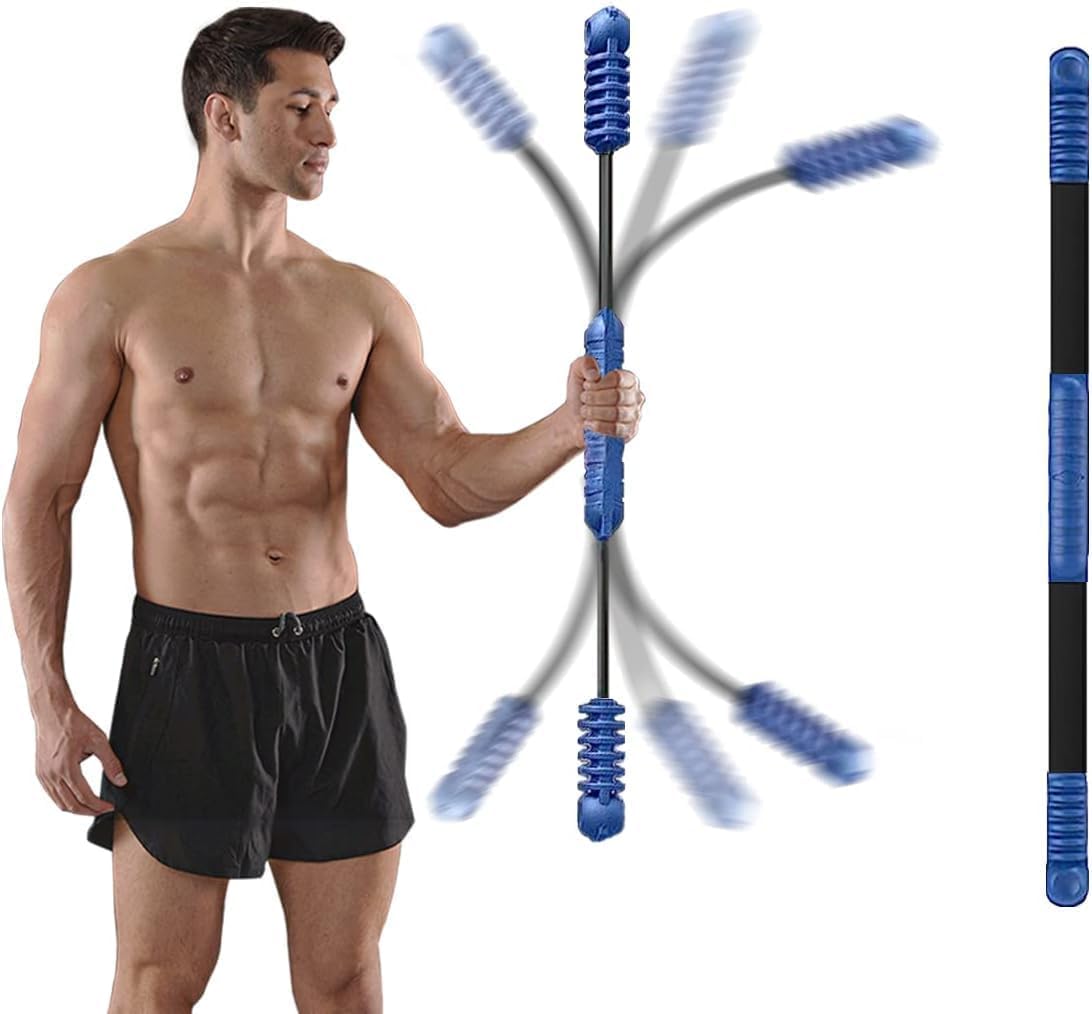
A note on how this pick works: the research below is about oscillating/flexible exercise bars as a category — mainly studies using the Flexi-Bar brand specifically. None of the trials tested this exact product. I’m recommending it because it’s a real, currently available, decently-rated oscillating bar (roughly 88% positive sentiment across its reviews) built on the same mechanism (a flexible rod you oscillate to create continuous vibration), not because it was itself a study subject. If you want the specific studied brand, Flexi-Bar-branded bars exist but availability on US Amazon has been inconsistent — check current listings before buying.
| Mechanism match | Same oscillating-rod mechanism as the studied devices; not the same brand or exact product as any cited trial |
| Study: Trunk activation | The trials below used Flexi-Bar-brand devices specifically — cited here as evidence for the oscillating-bar category, not as evidence for this exact product |
| Setup space | Roughly 2×2 m recommended for full range of motion |
| Learning curve | Technique-dependent — takes a few sessions to find a consistent oscillation |
| Storage | Compact, stores upright or flat |
What buyers say about the HOTWAVE Elastic Fitness Bar: Reviews skew positive (around 88% positive sentiment in third-party review analysis), with one reviewer specifically describing using it as a lower-cost alternative to a Bodyblade for rotator cuff rehab and finding it effective, though stiffer models take some getting used to. As with any lesser-known brand, it’s worth checking recent reviews for build-quality consistency before buying.
This is the best-supported use case for a flexi bar, and the one the product was originally designed around. A randomized trial (currently a preprint, not yet peer-reviewed) in 60 male recreational football players found that four weeks of Flexi-Bar training, three times per week, produced greater improvements in core endurance, dynamic balance, and hop performance than traditional core training[1]. A separate trial in university-aged adults found that flexi-bar training increased the thickness of the transversus abdominis and multifidus, with a clearer between-group advantage for the transversus abdominis, and improved balance test performance after six months[2]. In my view, these two muscles are ones that most conventional exercise programs struggle to target directly — that’s my own clinical read, not a finding from either trial.
Direct EMG evidence supports this activation, if not the specific plank/dead-bug comparison: a study comparing flexi-bar exercise to an identical non-vibrating bar in 20 healthy adults found significantly greater activation of the internal oblique, external oblique, and erector spinae during flexi-bar exercise, with the specific muscles affected varying by body posture (quadruped, side-bridge, or standing)[19]. Reflexive, proprioceptive responses to vibration are the proposed explanation for this increased activation. I want to flag that no trial cited in this article directly compared flexi-bar muscle activation to a plank or dead-bug exercise specifically — that comparison is my own framing, not a tested finding. What’s actually been measured across these trials is EMG muscle activation, muscle thickness on ultrasound, balance-test scores, and functional performance tests — not long-term injury-prevention or competitive-performance outcomes. If your goal is general core conditioning or a supplementary tool for athletic training, small trials support it. If you’re hoping it will specifically prevent a particular injury, that claim goes beyond what these trials measured.
Best Flexi Bar for Chronic Low Back Pain
Fitryo Total Bar

Same note as above applies here: the trials below tested Flexi-Bar-brand devices specifically, not this product. This is a real, established oscillating bar (4-star average, with detailed reviews including one from a physical therapist) using the same mechanism — a reasonable way to try the approach, not a claim that this exact bar was studied.
| Study: Comparison basis | Tested head-to-head against standard lumbar stabilization exercises in RCTs, not against no treatment |
| Session format in trials | Varies by trial: one used 10 sessions over 3x/week; another used 6 weeks, 3x/week, ~30 min/session |
| Best paired with | Supervised physiotherapy, not as a standalone substitute |
| Storage | Comes with a carrying case; length (59″) means it needs some overhead clearance |
What buyers say about the Fitryo Total Bar: Reviews are mixed-positive (4-star average); recurring themes include physical therapists reporting they used a similar tool professionally before buying one personally, and comparisons to Bodyblade noting this bar allows more varied (not just linear) oscillation patterns but needs more overhead clearance due to its length. A few reviewers note it takes some practice to find an effective rhythm.
Here the evidence is real but mixed, and it’s worth being precise rather than smoothing it into one tidy verdict. A randomized controlled trial in patients with chronic nonspecific low back pain compared flexi-bar exercises to standard stabilization exercises, both delivered alongside general physiotherapy. Both groups showed significant improvement in static and dynamic postural control after the intervention — but there was no significant difference between the flexi-bar group and the stabilization-exercise group[4]. A separate, smaller trial added a flexi-bar to stabilization exercises versus stabilization exercises alone over six weeks and found the opposite pattern on most measures: the flexi-bar group showed greater improvements in pain (VAS), disability (ODI), and transversus abdominis activation capacity than the stabilization-only group — the one exception was transversus abdominis thickness itself, which improved similarly in both groups[5]. A third small trial (n=30) added flexi-bar exercise to general physical therapy versus general physical therapy alone and found significantly greater improvement in both pain (VAS) and disability (ODI) in the flexi-bar group[15].
The honest summary: across these three small trials, results point in different directions — one found no advantage for flexi-bar over standard stabilization exercise, while two others found real advantages on most outcomes measured (pain, disability, muscle activation). That’s genuinely mixed evidence, not a clean “equivalent” or “superior” verdict — the trials differ in sample size, exact protocol, and which outcomes moved, and this likely isn’t the entire published literature on this specific question. It’s still a legitimate reason to consider one — it’s a genuine alternative if standard stabilization exercises feel repetitive or you want more real-time proprioceptive feedback — but the evidence doesn’t yet let me tell you confidently whether adding a flexi-bar meaningfully and consistently outperforms stabilization exercise alone. If cost is a concern, that’s worth knowing before you buy.
Best Flexi Bar for Shoulder Rehabilitation
Bodyblade Classic

| Design | Longer, flatter oscillating blade rather than a round bar — different form factor from Flexi-Bar, same underlying mechanism |
| Contraction rate (manufacturer spec) | Up to 270 contractions/minute |
| Study: Population studied | Athletes with traumatic anterior shoulder instability; separately, post-surgical rotator cuff repair patients |
| Weight | Classic model: 1.75 lbs (0.80 kg), manufacturer spec |
What buyers say about the Bodyblade Classic: Bodyblade reviews are frequently framed around physical-therapist recommendation, and a common comment is that many buyers were introduced to the device in a clinic before purchasing one for home use. Feedback on the Classic model tends to describe it as effective but requiring some coaching on technique to get full value from it; the heavier Pro version draws more comments about being genuinely more challenging rather than just more expensive.
The direct evidence here is better than a single case report, though it still comes with real caveats. A randomized controlled trial in 37 college athletes with traumatic anterior shoulder instability compared three 8-week protocols — traditional elastic-resistance exercise, Bodyblade (progressing from the Classic to the Pro model), and a mixed protocol combining both. All three groups improved significantly on a shoulder-instability symptom questionnaire (WOSI), with no significant difference between the Bodyblade and traditional-exercise groups on that primary outcome[7] — worth being precise here: this wasn’t an equivalence trial, so “no significant difference” isn’t the same as proof the two are equally effective, just that this study didn’t detect a difference between them. On a secondary functional reach test, the Bodyblade and traditional groups both outperformed the mixed-protocol group, which the researchers attributed to the mixed group only completing half the volume of either protocol — not to Bodyblade being inherently superior[7]. Separately, in a different population — patients recovering from rotator cuff repair surgery — a small randomized trial (n=20) found that a group doing combined sling exercise plus Flexi-Bar training, on top of standard postoperative care (TENS and continuous passive motion), improved muscle activity and reduced pain more than the standard-care-only group[6] — worth noting this tested a combination, not Flexi-Bar in isolation, and it’s a different device (Flexi-Bar, not Bodyblade) in a different shoulder condition than the RCT above.
I want to flag the limitations plainly rather than hedge around them: the shoulder-instability RCT found no significant WOSI difference between Bodyblade and standard elastic-band exercise — a genuinely useful finding (it’s a viable option, not a proven upgrade), but not the “this device works better” story a product page might imply, and not proof the two are truly equivalent either, since the study wasn’t designed to test that. The rotator-cuff trial is small, tested a combination intervention rather than Flexi-Bar alone, and had no long-term follow-up — I wouldn’t generalize it to all rotator cuff repair patients[6]. That doesn’t mean the tools don’t work — the mechanism (reflexive stabilizer-muscle activation without loading healing tissue under heavy resistance) makes clinical sense for early-stage shoulder rehab, which is likely why physical therapists already use devices like these. But if you’re recovering from shoulder surgery or instability, this belongs in a program your surgeon or physiotherapist has actually signed off on — not a self-directed purchase based on this article alone.
From a clinical perspective, I would not use a flexi bar as a standalone solution for shoulder stability, and I certainly would not view it as a replacement for physiotherapy. Isometric and eccentric strengthening exercises remain central to many shoulder rehabilitation programs, particularly when the goal is to restore strength, control, and tolerance to loading.
That said, I do think an oscillating bar can have a role as an additional tool within a broader rehabilitation program. In my view, its value is more likely to come from complementing established exercise-based rehabilitation rather than replacing it.
Best Flexi Bar for Balance and Fall-Risk Reduction in Older Adults
OSCILLATING SLIM Fitness Bar (2.0)

Same note applies here: the trials below tested Flexi-Bar-brand devices, not this product. This is a real, currently popular (“50+ bought in past month”), well-reviewed oscillating bar in the same mechanism category — its shorter “2.0” redesign may suit smaller spaces, which can matter for older adults training at home, but that’s a practical note, not a research finding.
| Stiffness | Some oscillating-bar manufacturers offer softer, shorter variants for users who find a full-length bar too difficult to control (including some seniors); this listing is on the shorter side already — worth checking the specific spec before buying if that matters to you |
| Study: Evidence status | Preliminary — small published studies of Flexi-Bar-brand devices specifically; a registered 60-participant study has no posted results |
| Session format | Best combined with existing balance training, not standalone |
| Supervision | Recommended for first sessions given fall-risk population |
What buyers say about the OSCILLATING SLIM Fitness Bar (2.0): This category has the least buyer-review signal specific to older-adult use — most reviews for this product come from a general fitness audience, not specifically seniors, though one reviewer specifically praised it for shoulder rehabilitation with a physical-therapy background. Treat review sentiment here as informative about the product’s build quality rather than its suitability for this particular population.
The clinical rationale for using a flexi bar in older adults centers on fall prevention: aging-related loss of lower-limb strength and balance is a well-established internal risk factor for falls, and vibration-based training has been proposed as a way to stimulate the reflexive neuromuscular responses that decline with age — that’s the background rationale a registered trial in this population gives for testing the approach, not yet a proven mechanism[3]. A recent small trial in adults aged 45–65 with type 2 diabetes and peripheral neuropathy — a population with impaired balance and elevated fall risk from nerve damage, not a general older-adult sample — found that adding active vibration training with a Flexi-Bar to a standard balance-exercise program produced greater improvements in postural control, balance-confidence, and fall-risk-index measures than balance training alone over six weeks[8]. Separately, Flexi-Bar has also been tested in a single-blind randomized trial of 80 general older adults (mean age 75.7) without diabetic neuropathy: a weekly 60-minute Flexi-Bar session over 12 weeks produced greater improvements than multi-component exercise in a 2-minute step test, a back-scratch flexibility test, and musculoskeletal discomfort[16] — but that trial did not measure falls or the same fall-risk-specific outcomes (postural sway, balance confidence) as the diabetic-neuropathy trial above, so it broadens the general-fitness evidence in older adults without directly supporting the fall-prevention claim this category is built around. Whether the fall-risk-specific finding from the diabetic-neuropathy trial holds in otherwise-healthy older adults is untested. A larger, purpose-built trial in community-dwelling older adults (65–85) comparing Flexi-Bar-plus-balance-training against balance training alone was registered under the same registry entry cited above, with a target of roughly 60 participants and an estimated completion date of December 2025[9] — worth checking for published results if this category matters to you — I could not confirm a peer-reviewed publication of its final results at the time of writing, so it’s a registered trial to watch for, not evidence you can rely on yet.
This is a genuinely promising but still-thin evidence base — closer to “early/promising” than “well-established.” The mechanistic story is reasonable, but direct evidence on fall-risk-related outcomes specifically comes from a single small trial in a specific clinical population (type 2 diabetes with peripheral neuropathy) rather than the general older-adult, fall-risk population this product is being recommended for here — I’m not aware of a published trial testing the same fall-risk-specific outcomes (postural sway, balance confidence, fall-risk index) in a general older-adult sample. I’m including a product recommendation here because the underlying exercise doesn’t involve heavy external loading and the user controls oscillation intensity, which makes it a plausible low-load option to try — but none of the small trials cited here included a structured safety analysis, so I can’t point to evidence establishing this as safe specifically for high-fall-risk populations. Treat this as a plausible addition to an existing balance program, not a substitute for structured fall-prevention exercise like Otago or Tai Chi, which has a much deeper evidence base. (This site also covers balance-training tools for a different population — athletic ankle-injury prevention rather than older-adult fall risk — worth a look if that’s closer to your situation.)
Do Flexi Bars Help with Bone Density in Postmenopausal Women?
You may have seen vibration training discussed for bone health in postmenopausal women — there is real research on this. But it’s important to be precise both about which device that evidence covers and about how settled it actually is, because it’s not the flexi bar, and the underlying evidence is more mixed than “proven” would suggest.
Standing whole-body vibration (WBV) platforms — which vibrate the entire body through the feet — have been studied for bone mineral density in postmenopausal women, and the picture is genuinely mixed rather than uniformly positive. Some meta-analyses report small improvements at specific sites such as the lumbar spine or hip under certain vibration protocols[10][11][12], while a 2024 overview of 15 systematic reviews on this exact question concluded that the evidence taken as a whole does not establish a clear, definitive BMD benefit from WBV in postmenopausal women, and did not recommend WBV specifically for this purpose[14]. More recent meta-analyses keep the picture mixed rather than resolving it: a separate 2024 meta-analysis of 13 randomized trials (783 postmenopausal women with osteoporosis specifically) reported small but statistically significant improvements in lumbar spine and femoral neck BMD[17], while a 2026 updated meta-analysis in older adults generally (14 studies, 1,447 participants) found significant improvements at some skeletal sites (Ward’s triangle, greater trochanter, femoral neck) but not others[18]. Either way, that entire evidence base — positive, mixed, and cautious alike — specifically involves commercially available standing WBV platforms, tested via randomized controlled trials of people standing on the device.
A flexi bar is mechanically a different device: it’s a hand-held oscillating rod that loads the arms, shoulders, and trunk through voluntary swinging, not a whole-body platform that transmits vibration through the skeleton via the feet while standing. I was not able to find a published trial testing hand-held oscillating bars specifically for bone mineral density outcomes in any population. The reflexive muscle activation flexi bars produce is a real, separately-studied effect (see the core-stability section above), but “muscle activation” and “osteogenic loading sufficient to change bone density” are not automatically the same thing, and no study has tested whether the flexi-bar mechanism produces the latter.
If bone density is your primary goal, a flexi bar is not where the research points. Standing whole-body vibration platforms at least have some direct research behind them, although the evidence is genuinely mixed, whereas I was not able to find comparable bone-density studies on flexi bars themselves. If you want to look more closely at that category, see our Best Vibration Plates article, where I go through both the potential benefits and the limitations of the evidence in more detail.
From a clinical perspective, though, I would not get too fixated on finding one supposedly perfect type of exercise for bone health. The more important point is often that the person is physically active in the first place. In practice, a sustainable form of regular exercise is usually more useful than a theoretically ideal program that the patient does not actually follow.
This is also how I tend to approach the broader picture in practice. Exercise is only one part of bone health, and vitamin D status and adequate calcium intake can also become relevant. So while the exact type of training does matter to some extent, I would generally put more emphasis on helping the patient stay active consistently than on obsessing over whether one specific exercise modality is optimal.
Are Flexi Bars Good for Youth Coordination and Balance?
Flexi-Bar sells a shorter “Kids” model specifically marketed for children’s balance and coordination development. The direct evidence for this application in youth populations is limited to one small study in juvenile soccer players (10 exercise, 10 control, ages in their teens) that found eight weeks of flexi-bar training improved postural alignment and balance ability compared with a no-training control group[13]. That is a very different level of evidence from controlled trials designed around general childhood motor development, so I would be careful not to stretch this sport-specific finding into a broader claim that flexi bars improve coordination in children generally.
From a practical perspective, I would also put this in the wider context of how children usually develop physical skills. For most children, the bigger priority is not finding one specialized training device, but getting plenty of varied movement and opportunities to develop fundamental motor skills across different activities. A flexi bar may have a place for a young athlete when trunk control or balance is a specific training goal, but I would see it as an optional addition rather than a central tool for childhood development.
If you want the broader age-by-age perspective on what children benefit from training, I cover that separately in What Should Kids Train at Each Age?.
Comparison Table
This table is a navigation aid to help you find the right category quickly — not a ranking of one product against another.
| Use case | Product | Evidence strength | Best for |
|---|---|---|---|
| Core/trunk stability | HOTWAVE Elastic Fitness Bar | Real, direct (RCTs on Flexi-Bar brand) | General fitness, athletes |
| Chronic low back pain | Fitryo Total Bar | Mixed — 3 small trials, 2 favorable, 1 no advantage (Flexi-Bar brand) | Alternative to conventional stabilization work |
| Shoulder rehab | Bodyblade Classic | Real RCT — no significant WOSI difference vs. standard exercise | Comparable alternative under clinical guidance |
| Balance/fall risk (older adults) | OSCILLATING SLIM Fitness Bar | Early/promising, thin (Flexi-Bar brand) — fall-risk evidence specific to diabetic neuropathy; separate general-fitness RCT exists for older adults broadly | Addition to an existing balance program |
| Bone density (postmenopausal) | No pick | No evidence for this device type | See Best Vibration Plates instead |
| Youth coordination | No pick | Thin, sport-specific only | Ask a youth sports physiotherapist |
FAQ
Is a flexi bar the same thing as a vibration plate? No. A flexi bar is a hand-held oscillating rod you swing with your arms and trunk. A vibration plate is a standing platform that vibrates through your feet. They engage the body differently, and — importantly — the research supporting each is largely separate. Don’t assume evidence for one transfers to the other; the bone-density section above is a direct example of where that assumption breaks down.
How often do I need to use it to see results? There’s no single evidence-based Flexi-Bar dose — protocols across the trials cited here vary a lot. The football-player trial used 3 sessions/week for 4 weeks; the low back pain trials used 6 weeks and 10 sessions respectively, at roughly 30 minutes per session; and the trunk-thickness trial in university students ran for 6 months. Most studies used structured protocols, several explicitly supervised, but the evidence doesn’t establish an optimal frequency or whether unsupervised home use produces equivalent results.
Can I use a flexi bar if I have an existing back or shoulder injury? The rehabilitation evidence above was collected under supervised physiotherapy conditions, not self-directed home use. If you have an active injury, check with the clinician managing it before adding this on your own.
Which stiffness level should I buy? Flexi-Bar (the studied brand) offers a softer “Kids” version, a mid-stiffness “Standard” version, and stiffer “Intensive”/”Athletic” versions for more advanced users. The specific product linked in this article isn’t a Flexi-Bar-branded device, so check its own listed length/weight/stiffness rather than assuming it maps onto that lineup. None of the trials above compared stiffness levels directly against each other, so there’s no research-based answer to which stiffness produces a better outcome — this is a comfort/preference choice, not an evidence-based one.
What This Means for Buyers
If you want general core conditioning or you’re an athlete looking for a low-impact stability tool, oscillating-bar exercise has the best-supported (though still small-trial) evidence behind it — I’ve linked the HOTWAVE Elastic Fitness Bar, a real, decently-rated, currently available oscillating bar, rather than the specific Flexi-Bar-branded devices used in the trials, since those have had inconsistent US Amazon availability; if you specifically want the studied brand, look for current Flexi-Bar listings directly. If chronic low back pain is your main concern, the evidence is genuinely mixed across three small trials — two found a real advantage for oscillating-bar exercise, one found none — so treat it as a reasonable alternative to try, not a proven upgrade; I’ve linked the Fitryo Total Bar here as a different, well-reviewed option in the same category. For shoulder rehabilitation, Bodyblade Classic has real randomized evidence in athletes with traumatic anterior shoulder instability, where the study found no significant difference from conventional elastic-resistance rehab; a separate small study also tested Flexi-Bar (combined with sling exercise) after rotator cuff repair. Either way, this belongs in a clinician-guided program rather than a self-directed purchase. For older adults concerned about falls specifically, the one trial on fall-risk outcomes was conducted in people with diabetic peripheral neuropathy — a separate trial found general fitness benefits (step test, flexibility, discomfort) in healthy older adults, but didn’t measure fall risk — so treat the fall-prevention data as encouraging but population-specific, and add it to — not replace — an existing balance program; the OSCILLATING SLIM Fitness Bar linked here is a compact, well-reviewed option if you want to try it. And if bone density is why you’re here, a flexi bar isn’t the product the evidence supports — a whole-body vibration platform at least has some (mixed) evidence behind it.
More broadly, this is how I would frame the entire category clinically: oscillating bars are not something I would use as a stand-alone treatment or as a replacement for physiotherapy, strength work, balance training, or other established parts of rehabilitation. They are a relatively newer training tool, and while there is already more research than I initially expected, the evidence base is still too limited and heterogeneous to support standardized, long-term clinical recommendations. There is no widely established protocol for exactly which device to use, how stiff it should be, how long each session should last, or which patients are most likely to benefit.
For that reason, I see flexi bars and similar oscillating devices mainly as an adjunct that may be worth trying when they fit into an otherwise sensible rehabilitation or training program. In practice, that means using them as one tool among several rather than building the entire program around them. The research is interesting enough that I would no longer dismiss the category, but there is still not enough clinical experience or standardization for me to present it as an established treatment in its own right.
References
- https://www.researchsquare.com/article/rs-7061729/v1
- https://www.researchgate.net/publication/301707876_The_effect_of_flexi-bar_exercise_with_vibration_on_trunk_muscle_thickness_and_balance_in_university_students_in_their_twenties
- https://www.centerwatch.com/clinical-trials/listings/NCT05688553/the-effects-of-using-flexi-bar-for-balance-and-strength-training-on-the-balance-and-muscle-in-community-dwelling-older-adults
- https://pmc.ncbi.nlm.nih.gov/articles/PMC11099866/
- https://www.researchgate.net/publication/323506872_Effects_of_stabilization_exercise_using_flexi-bar_on_functional_disability_and_transverse_abdominis_thickness_in_patients_with_chronic_low_back_pain
- https://pmc.ncbi.nlm.nih.gov/articles/PMC5088147/
- https://ijspt.scholasticahq.com/article/65900-bodyblade-training-in-athletes-with-traumatic-anterior-shoulder-instability
- https://www.ijfmr.com/papers/2026/1/64963.pdf
- https://clinicaltrials.gov/study/NCT05688553
- https://www.ncbi.nlm.nih.gov/pmc/articles/PMC5132247/
- https://pubmed.ncbi.nlm.nih.gov/27145947/
- https://www.sciencedirect.com/science/article/pii/S0965229922000139
- https://koreascience.or.kr/article/JAKO201504641500325.page
- https://pubmed.ncbi.nlm.nih.gov/39107743/
- https://pmc.ncbi.nlm.nih.gov/articles/PMC5788768/
- http://www.sgecm.org.tw/ijge/journal/detail.asp?id=515
- https://pmc.ncbi.nlm.nih.gov/articles/PMC11540256/
- https://link.springer.com/article/10.1186/s12891-026-09504-7
- https://pmc.ncbi.nlm.nih.gov/articles/PMC4540862/