

Best Office Chair: What the Research Actually Supports (and What It Doesn’t)

Table of Contents
Back pain is one of the most common reasons people come to see me in occupational health—roughly the third most common in my own clinical workload. Many of these patients are office workers. The pain may first appear during something surprisingly ordinary, such as bending down to pick something up from the floor, but the broader context often includes long working days spent sitting and relatively little variation in posture. That does not mean prolonged sitting is the cause of every episode of back pain, but from a clinical perspective, the way someone spends eight hours of the working day is difficult to ignore.
That is also why I think the office chair matters—but probably not in the way most “best office chair” lists suggest. Search online and you will find chairs ranked by comfort tests, premium features, and brand reputation. Research asks a narrower and more useful question: does changing the chair actually reduce pain or discomfort in people who sit for work?
The answer is less satisfying than the marketing. The evidence is limited, varied, and mixed when it comes to pain. Older chair-intervention studies often involved adjustable chairs together with guidance on how to use them, while newer reviews include a much broader range of chair designs. What the research does not give us is a clear winner by brand or price.
So I wrote this guide differently. I am not trying to crown one universal “best office chair.” Instead, I look at different use cases, how much evidence supports each one, and where the research is too weak to justify a product recommendation at all. The evidence tiers are my own plain-language classification rather than formal GRADE ratings. Where I make a pick, it is because the product fits the practical features discussed in the research—not because a clinical trial has shown that particular chair to be superior.
Some of the links on this site are affiliate links. If you purchase a product through these links, I may earn a commission. This doesn’t cost you anything, but it helps me maintain this page so I can continue to share free information with the world. As an Amazon Associate, I earn from qualifying purchases. Product links are provided for informational and convenience purposes only. Their inclusion does not constitute medical or nutritional advice or a personalized recommendation.
Best Office Chair at a Glance

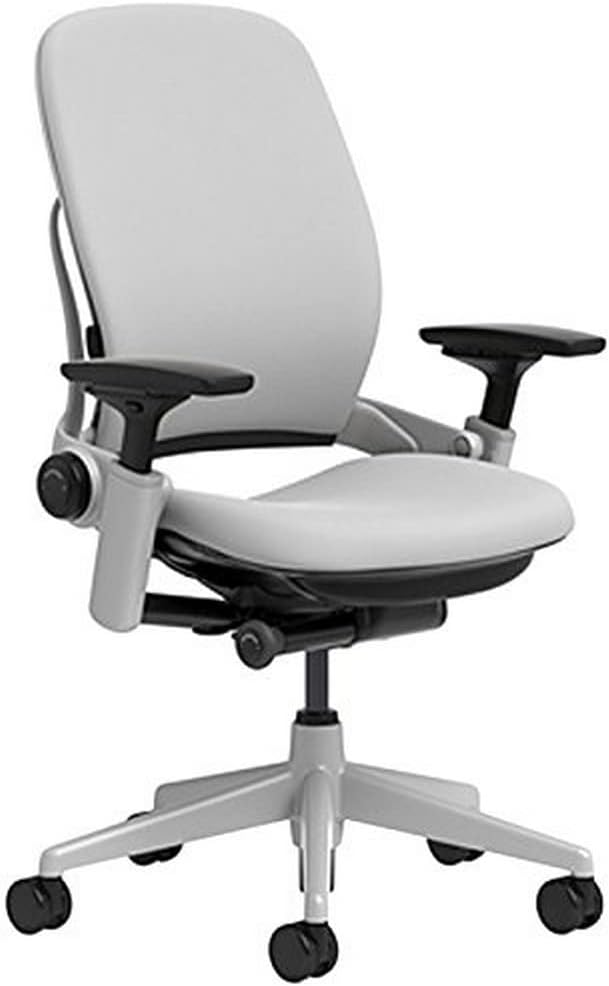
| Branch Ergonomic Chair | Steelcase Leap |
| Best for: most desk workers | Best for: taller or heavier users |
| ✅ Adjustable seat depth ✅ Easy assembly | ✅ Wide adjustment range ✅ 400 lb listed capacity |
| ⚠️ Narrow seat, 275 lb limit ⚠️ Small recline angle | ⚠️ Premium cost ⚠️ Less breathable than mesh |
| Evidence: low-certainty for pain | Evidence: low-certainty for pain |
No pick for dynamic sitting, armrests, or stability ball chairs (sections 3–5).
1. Best Office Chair for Most Desk Workers With Back Discomfort: Branch Ergonomic Chair
Evidence tier: low-certainty for pain; more consistent for comfort. The most defensible best office chair here is an adjustable one, mainly for comfort and because the chair interventions in the research were adjustable chairs, usually with training. No review shows that adjustability reduces back pain, and the research does not point to any brand or price tier.
| Pros | Cons |
|---|---|
| Seat depth adjusts, so the seat can be fitted to different leg lengths | Seat pan runs relatively narrow, and the manufacturer’s weight limit is 275 lb |
| Lumbar rest adjusts in height and can be removed | Armrest pads feel hard to some testers and can drift out of position |
| Breathable mesh back, with thick, high-density seat foam | Tilt-tension knob is awkward to reach, and the recline angle is smaller than most competitors’ (testers did not feel constrained) |
| Easy assembly and strong customer scores | One tester found the seat firmer than a competing chair’s |
| Study: in the five chair-intervention studies reviewed, all reported less self-reported pain immediately afterward | Study: none of the studies cited here report testing this chair |
Branch Ergonomic Chair is a mid-range mesh chair with adjustable seat height, adjustable seat depth, and a height-adjustable, removable lumbar rest [1].
What buyers say about the Branch Ergonomic Chair: Customer ratings on Branch’s own site are strongly positive across thousands of reviews, and most reviewers say they would recommend the chair [1]. Independent testers largely agree. TechGearLab credits the wide adjustability for the price class, the easy assembly, and the comfortable mesh-and-foam build, and names it the best pick for most people [2]. TechRadar’s reviewers liked the removable lumbar rest and the adjustable armrests [3]. The recurring complaints are narrow: armrest pads that become less comfortable over time and sometimes shift, and a tilt-tension knob that is awkward to reach [2]; a seat that one tester found firmer than a competing chair’s [4]; older reviews note the lack of a headrest, though the current product page lists one as an optional add-on [1]; and a weight limit lower than some competitors [2].
What the research supports. A 2012 systematic review of workplace chair interventions found five studies, three of them randomized trials, in workers who sit for prolonged periods: three in garment factories, one in an office, and one in university students. All five reported lower self-reported musculoskeletal pain immediately after the intervention. The studies were too varied in design and outcome measures to pool, the risk of bias was moderate because of weak randomization and missing allocation concealment, and the authors concluded that the evidence was only moderate and that strong recommendations had to wait for further trials. The review also notes that, anecdotally, matching seat height and seat-pan depth to the user’s body is the most commonly recommended adjustment [5].
More recent reviews are less optimistic about pain. A 2022 systematic review of chair interventions in office workers (14 studies: 2 randomized trials, 10 repeated-measures studies, and 2 prospective cohort studies) found conflicting effects on pain and discomfort, rated the evidence very low to low quality, and concluded that, unless higher-quality studies show otherwise, chair interventions are not recommended to reduce low back pain or discomfort [6]. A 2026 systematic review of 32 randomized trials (1,637 participants) of ergonomic chairs reported positive and consistent results for comfort, mixed results for pain, and no significant effect on disability; the authors say dynamic and adjustable chairs provide comfort and biomechanical support, while pain benefits are inconsistent [7].
A 2022 cluster-randomized trial in 61 office workers (31 intervention, 30 control; mean age 29) tested workstation adjustment carried out by a physiotherapist. Head flexion, upper-back flexion, and upper-arm elevation all decreased significantly, and perceived discomfort fell by 22.1 mm in the adjusted group while rising by 7.2 mm in the control group. Upper-arm elevation and perceived discomfort were still lower than at baseline at the 3-month follow-up (the discomfort comparison was reported as p<0.01) [8]. This tested a guided adjustment of the whole workstation in a small, young sample, not a particular chair model.
A 2025 meta-analysis of randomized trials of ergonomic interventions in general (the abstract reports 24 trials and 4,086 workers; the results text reports 25 trials and 2,981 workers, with one study not pooled) found lower odds of reported low back pain. The paper is internally inconsistent on the size of the effect: the abstract gives OR 0.53 (95% CI 0.40–0.70), while the results text gives a pooled OR of 0.58 (95% CI 0.43–0.80). The authors describe the effect as small, say it raises concerns about clinical significance, and say ergonomic interventions should be integrated with physical therapy, rehabilitation, and strength training. Ergonomic chairs are listed among the interventions covered, but the pooled result is for ergonomic interventions as a group, and the paper reports no external funding or conflicts of interest [9].
These reviews are why the tier is low-certainty for pain rather than higher. The 2012 review’s five studies all reported immediate reductions, but it called the evidence only moderate; the 2022 review graded the broader chair evidence very low to low; and the 2026 review found inconsistent pain results alongside more consistent comfort benefits. The studies cited here do not show that any chair model, brand, or price tier outperforms another. What they most consistently involve is adjustable chairs, often used with training in how to adjust them, so adjustability is a reasonable feature to prioritize, mainly for comfort. The Branch Ergonomic Chair is included as a real example of a chair with adjustable seat height, seat depth, and lumbar support at a mid-range cost, not because evidence favors it over similar chairs.
From a practical work perspective, the chair also needs to be comfortable and easy to adjust. In many workplaces, the basic ergonomics are reasonably well thought out, but remote work has changed the picture. I increasingly hear about people working from home at a kitchen table, sometimes sitting for hours on an ordinary dining chair that was never designed for a full working day.
In my view, home ergonomics are worth taking seriously for exactly this reason. That does not mean everyone needs an expensive office setup, and a better chair is not a guarantee against back pain. But if you spend a large part of your working week at home, investing in a comfortable chair and a workstation that can be adjusted to you may be more important than making the room look perfectly styled. From a health perspective, I would generally put function before aesthetics when the same setup is used for hours every day.
2. Best Office Chair for Taller, Heavier, or Differently Sized Users: Steelcase Leap
Evidence tier: low-certainty for pain, inherited from the general chair evidence. The 2012 review describes matching seat height and seat-pan depth to the user’s body as, anecdotally, the most commonly recommended adjustment, and, in my reading, fit gets harder at the edges of a chair’s range. The Branch Ergonomic Chair above has a 275 lb manufacturer weight limit [1] and a relatively narrow seat pan [2], so people outside its range need a chair built for a wider one when shopping for the best office chair.
| Pros | Cons |
|---|---|
| Adjustable seat depth; a 6’2″ reviewer said it removed the perched feeling of fixed-seat chairs | Premium cost |
| Lumbar height and back firmness both adjust | Cushioned seat and back are less breathable than a mesh chair |
| Four-way adjustable armrests that reviewers praise | Armrest padding gets mixed comments |
| High weight capacity (400 lb listed by TechGearLab) | One reviewer found the recline less fluid than hoped and slightly wobbly when tightened |
| Long manufacturer warranty | One reviewer found the seat flat and not very soft |
| Study: the fit logic comes from the chair-intervention review | Study: the studies cited here do not show that it outperforms other chairs or address taller or heavier workers |
Steelcase Leap is a premium, fully adjustable chair with adjustable seat depth, height-adjustable lumbar support with back-firmness control, and four-way armrests [10]. It is included for its broad adjustment range and a 400 lb listed capacity [11], not because evidence says premium chairs work better.
What buyers say about the Steelcase Leap: Independent reviewers place it at or near the top of the task-chair category. TechGearLab names it its luxury pick and lists a 400 lb capacity [11]. Two independent reviewers who used it for months recommend it despite its flaws: one, after about a year, calls it his default recommendation for an ergonomic task chair [12], and the other, writing after three months with a refurbished unit, still calls it worth considering [13]. Praise centers on the adjustment range, the sliding seat (the 6’2″ TechRadar reviewer said it pleased him most) [14], and the armrests, which the first reviewer treats as a reference other chairs should be judged against [12]. Complaints are mostly individual: cushioned seats are less breathable than mesh [14], and the first reviewer found the chair uncomfortably hot at 25°C or more [12]; the second reviewer found the seat a little flat and the recline less fluid than he hoped, with slight wobble when the recline is tightened, though his unit was refurbished [13]; and the TechRadar reviewer would have liked a touch more softness in the armrests [14], while the first reviewer calls the armrest material soft [12]. One reviewer’s first unit was noisy, and the dealer replaced the mechanism and later sent a brand-new chair [12].
What the research supports. The evidence cited here does not show that the Steelcase Leap is better than competing chairs, and no study I found compared chairs by price or brand. Steelcase’s research page identifies an office study by Amick and colleagues as having used the Steelcase Leap together with ergonomics training, in three groups: chair with training, training alone, and control [15]. An Upjohn Institute working paper on the same three-group design describes it as quasi-experimental and states that the research was supported by grants from Steelcase Corporation, which also funded the data collection [16]. A study built that way, and funded by the manufacturer, speaks to adjustable chairs with training in general, not to the Steelcase Leap over its competitors, and should be read with that funding in mind. The reason this category exists is the point from the 2012 review that matching seat height and seat-pan depth to the user’s body is, anecdotally, the most commonly recommended adjustment [5]. A chair with a small adjustment range or a low weight limit cannot be matched to everyone. The 2022 trial [8] and the 2025 meta-analysis [9] above apply here with the same limits.
3. Best Office Chair for Dynamic Sitting? A Preliminary Signal, but No Matching Product
Evidence tier: early and mixed. No best office chair pick. The positive cushion trial used a custom air-filled seat cushion that is under a patent application, so retail wobble cushions and “active sitting” seats are not what these trials tested. The other trial, of a motor-driven rotating chair, found no advantage in people who already had lumbar pain.
In a 6-month cluster-randomized trial in Thailand (7 organizations, 133 high-risk office workers without neck or low back pain in the previous 6 months: 67 intervention, 66 control), a dynamic air-filled seat cushion was compared with a placebo foam pad. Low back pain developed in 10% (7/67) of the cushion group and 59% (39/66) of the placebo group (adjusted hazard ratio 0.16, 95% CI 0.07–0.35). Neck pain developed in 15% versus 65% (adjusted HR 0.19, 95% CI 0.09–0.39). Among workers who did develop pain, pain intensity and disability did not differ between groups [17].
The funding and ownership details matter. The trial was supported by the National Research Council of Thailand and two university funds, with partial financial support from an auto-seat manufacturer (Srithai Auto Seats) that the authors say did not interfere with the study. Two of the authors are listed inventors on the cushion’s patent application and may benefit financially [17]. A follow-up secondary analysis of the workers who developed pain reported shorter recovery with the cushion, but could not confirm fewer recurrences because the sample was small [18].
A separate randomized multicenter trial compared a motor-driven chair with horizontal rotary seat movement against an identical chair without the rotation function in 280 people with lumbar pain, with a 2-year follow-up; some participants withdrew before the chairs were delivered, and follow-up data for the primary endpoint were available for 82.5% of participants. Disability scores (Oswestry Disability Index, p=0.59) and days absent from work (p=1.00) did not differ, and the authors concluded that passive rotary dynamic sitting was not superior to sitting in a high-quality, ergonomically designed chair [19].
The two trials ask different questions, preventing new pain in workers without recent neck or back pain versus treating existing lumbar pain, and used different devices, so they do not directly contradict each other. Neither supports buying a particular retail product. The unusually large effect also needs to be read in light of baseline differences between the two groups in the cushion trial (including sex, years of employment, psychosocial work factors, and trunk muscle endurance) across only seven randomized clusters; the authors note that this could potentially exaggerate the perceived effectiveness [17]. A large effect in one cushion trial, in which two authors hold a patent interest, needs independent replication before it should drive purchases.
Based on the studies discussed here, dynamic sitting does not currently look clearly better than conventional sitting. The idea of combining movement with sitting is interesting, but the evidence is still too limited and inconsistent for me to view dynamic chairs or cushions as an especially promising solution.
In practice, I would put more emphasis on changing position during the day rather than trying to make the sitting itself “active.” Alternating between sitting and standing, adjusting desk height when possible, getting up regularly, and adding brief movement breaks may be a more practical way to reduce long periods in one static position. From a clinical perspective, I would rather encourage variation throughout the working day than rely on a chair or cushion that is designed to create movement while you remain seated.
4. Best Office Chair for Neck and Shoulder Strain? Armrests Offer Indirect Evidence, No Pick
Evidence tier: indirect. No pick. The positive finding in the Cochrane review concerns an arm support combined with an alternative computer mouse, not chair armrests, and the same review found no effect from workstation adjustment on upper limb pain or discomfort.
A Cochrane review of ergonomic interventions for preventing upper limb and neck disorders in office workers included 15 randomized trials with 2,165 participants. Two studies of an arm support combined with an alternative mouse gave moderate-quality evidence of fewer neck or shoulder musculoskeletal disorders (RR 0.52, 95% CI 0.27–0.99), but not fewer right upper limb disorders (RR 0.73, 95% CI 0.32–1.66). The upper bound of the neck and shoulder interval is 0.99, so the estimate is uncertain. An alternative mouse alone did not produce a considerable reduction. Workstation adjustment (one study) and sit-stand desks (one study) did not reduce upper limb pain or discomfort compared with no intervention, and the authors call for further high-quality studies [20].
Adjustable armrests remain a sensible feature to look for as a comfort feature. The evidence does not show that chair armrests prevent neck or shoulder problems, and both chairs above are included for other reasons.
To me, this comes back to the same broader point: no chair feature really solves the problem of spending too much of the day in one position. Armrests may make sitting more comfortable, but they do not turn prolonged sitting into movement, and the evidence here does not show that chair armrests prevent neck or shoulder problems.
From a clinical perspective, I would focus less on trying to perfect one static sitting position and more on creating variation during the day. Changing posture, standing up, walking briefly, and generally breaking up long periods of sitting may be more useful ways to think about the problem than expecting a particular armrest or chair design to compensate for remaining still for hours.
5. Stability Ball Chairs: One Trial Found No Benefit for Back Pain
Evidence tier: one small trial, no benefit shown. No pick. Sitting on an exercise ball instead of a chair is a popular idea for back pain, but the randomized trial cited here found no benefit for pain or disability.
In a randomized crossover study that recruited 90 participants (university students, staff, and faculty aged 18–65 who sat at least 4 hours a day) sat on a stability ball 5 days a week for 8 weeks, building up to 90 minutes a day, or used their usual chairs. Pain and disability did not differ significantly between conditions (P>0.05), and ball sitting did not prevent low back pain from increasing over the 8 weeks. Some core endurance measures improved: isometric trunk flexion (between-group P=0.005) and the Sorensen test (between-group P=0.010). The authors concluded that ball sitting had no significant effects on low back pain or disability but improved core endurance in the sagittal plane; they said it may be useful as an adjunct when core muscles are involved, but that clinicians should rely on other evidence-based treatments for low back pain [21].
The randomized trial cited here does not support replacing an office chair with a stability ball to reduce low back pain or disability.
Best Office Chair Comparison Table
This best office chair comparison table is a navigation aid, not a ranking.
| Use case | Evidence tier | Pick | Main limitation |
|---|---|---|---|
| Most desk workers with back discomfort | Low-certainty for pain; more consistent for comfort | Branch Ergonomic Chair | Evidence concerns adjustable chairs in general, not this model |
| Taller, heavier, or differently sized users | Same (inherited) | Steelcase Leap | Premium cost; evidence does not show it beats other chairs |
| Dynamic sitting chairs and cushions | Early and mixed | No pick | Positive trial used a newly designed study cushion with inventor interests and baseline imbalance |
| Armrests for neck and shoulder strain | Indirect | No pick | Evidence concerns an arm support plus alternative mouse |
| Stability ball as a chair | One small trial, no benefit shown | No pick | No benefit shown for pain or disability; possible adjunct role for core endurance |
FAQ
Is the best office chair for back pain an expensive one? The studies cited here did not compare price tiers or brands. They primarily evaluated adjustable chair interventions, usually alongside training in how to adjust the chair [5], so the premium pick above is about adjustment range and body fit, not proven better outcomes.
Will a new chair fix my back pain? Probably not on its own: none of the studies cited here shows that replacing a chair alone resolves established back pain. A 2025 meta-analysis found only small effects from ergonomic interventions and recommended integrating them with physical therapy, rehabilitation, and strength training [9], and a 2022 review of chair interventions graded the evidence for back pain and discomfort very low to low [6].
What should I look for in the best office chair? Adjustable seat height and training in how to use the chair were common features of the interventions in the 2012 review [5]. Both picks above also have height-adjustable lumbar support, but the review did not isolate lumbar support as the active ingredient.
Do sit-stand desks help with upper limb pain? In the Cochrane review of office workers, one study of sit-stand desks found no effect on upper limb pain or discomfort compared with no intervention [20].
What This Means for Best Office Chair Buyers
- Most desk workers with back discomfort: buy for adjustability, and set it up to fit your body. The Branch Ergonomic Chair is a mid-range example, and the evidence behind the category is low-certainty for pain and more consistent for comfort.
- Taller, heavier, or differently sized users: check the adjustment range and weight limit first. The Steelcase Leap has a broad adjustment range, at a premium cost, with the same evidence limits.
- Dynamic sitting chairs and cushions: the early signal is interesting but rests on a study-specific cushion and a single cushion trial. No pick.
- Armrests for neck and shoulder strain: a comfort feature, not a proven intervention. No pick.
- Stability ball chairs: the one randomized trial cited here found no benefit for back pain or disability. No pick.
Comfort is still a valid reason to improve a workstation. Even if a more comfortable chair does not meaningfully reduce back pain, feeling better while you work can still improve the experience of spending long hours at a desk. In that sense, comfort has value on its own and does not need to be justified as a treatment for pain.
What I would avoid is expecting comfort features to solve a back-pain problem by themselves. A better chair may make sitting more pleasant, but it does not replace movement, exercise, or, when appropriate, physiotherapy. From a clinical perspective, I see the chair as one part of the working environment rather than the main treatment for back pain.
References
- https://www.branchfurniture.com/products/ergonomic-chair
- https://www.techgearlab.com/reviews/small-and-home-office/office-chair/branch-ergonomic
- https://www.techradar.com/reviews/branch-ergonomic-chair
- https://tomsguide.com/reviews/branch-ergonomic-chair
- https://link.springer.com/doi/10.1186/1471-2474-13-145
- https://pubmed.ncbi.nlm.nih.gov/33970803/
- https://ptj.uswr.ac.ir/article-1-837-en.html
- https://www.sciencedirect.com/science/article/abs/pii/S0003687022000618
- https://www.mdpi.com/2077-0383/14/9/3034
- https://shop.steelcase.com/products/steelcase-leap
- https://www.techgearlab.com/topics/small-and-home-office/best-office-chair
- https://blog.szynalski.com/2019/04/review-steelcase-leap/
- https://otfocus.com/steelcase-leap-long-term-review-and-why-its-still-my-favorite/
- https://www.techradar.com/reviews/steelcase-leap-review
- https://www.steelcase.com/asia-en/research/articles/topics/wellbeing/leap-productivity-health-impact-study/
- https://research.upjohn.org/up_workingpapers/95/
- https://www.sjweh.fi/show_abstract.php?abstract_id=4184&fullText=1
- https://link.springer.com/article/10.1186/s12891-024-07947-4
- https://www.sciencedirect.com/science/article/abs/pii/S1529943006007510
- https://www.cochranelibrary.com/cdsr/doi/10.1002/14651858.CD008570.pub3/full
- https://pubmed.ncbi.nlm.nih.gov/27010995/




